
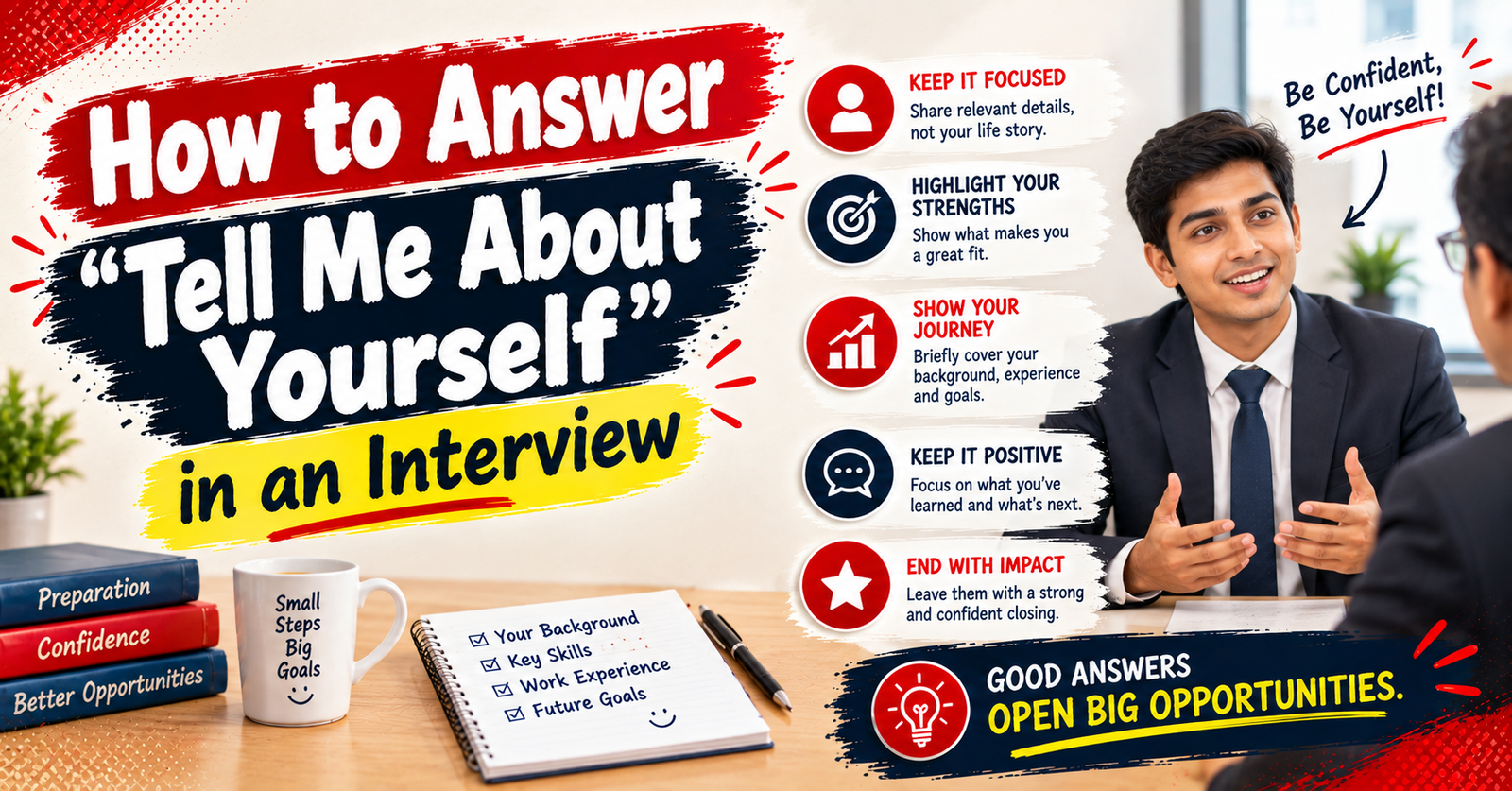
I bombed this question in my very first real interview. Not because I didn't know the answer — I knew my own life pretty well, obviously — but because I had no idea what they actually wanted to hear. So I just... started talking. Childhood, college, that one internship, a random hobby I thought made me sound interesting. Five minutes later the interviewer's eyes had that polite-but-tired look, and I knew I'd lost them somewhere around minute two.
Turns out almost everyone fumbles this question at least once, because it feels so open-ended that it tricks you into thinking there's no wrong way to answer it. There absolutely is a wrong way. And there's a pretty reliable right way too, once you see the pattern.
Why This Question Trips People Up
It's usually the very first question in an interview, which means two things. One, you're still a little nervous, not fully warmed up. Two, whatever you say here sets the tone for everything after. Interviewers aren't actually asking for your life story — they're asking you to prove, in under two minutes, that you understand what matters for this role and can talk about yourself with some structure.
Most people either go too broad (literally starting from childhood) or too narrow (just reciting their resume line by line, which the interviewer already has in front of them anyway).
The Structure That Actually Works
There's a pretty well-known framework here, sometimes called Present-Past-Future, and honestly it works because it mirrors how people naturally tell a coherent story.
| Part | What Goes Here | Rough Time |
|---|---|---|
| Present | What you're doing right now, in your current or most recent role | 20-30 seconds |
| Past | A quick path of how you got here — key experience, not your whole history | 30-45 seconds |
| Future | Why you're interested in this specific role, connecting it back to where you're headed | 20-30 seconds |
Total answer should land somewhere around 90 seconds to two minutes. Shorter than people expect, honestly. If you're going past two and a half minutes, you've probably drifted into territory that belongs in a later question, not this one.
An Example, So This Isn't Just Theory
Let's say you're a marketing professional interviewing for a senior role at a new company. Something like this:
"Right now I'm leading content strategy for a mid-size SaaS company, managing a small team and handling everything from campaign planning to performance tracking. Before that, I spent about three years on the agency side, which honestly gave me a pretty broad view of different industries early on — that's where I first got into data-driven content, which is still a big part of how I work today. What's drawing me to this role specifically is the chance to build something closer to in-house, where I can actually own the long-term strategy instead of jumping between client accounts every few months."
Notice what's missing — no childhood, no unrelated hobbies, no apologizing for a career gap nobody asked about yet. It's tight, it connects past experience to this specific opportunity, and it gives the interviewer a natural follow-up to ask about.
Common Mistakes People Make
- Starting from way too far back — nobody needs to know what you studied in school if it was fifteen years ago and unrelated
- Just reading your resume out loud, word for word, adding nothing new
- Going on for five-plus minutes because the question felt like an invitation to share everything
- Not connecting anything back to the actual role you're interviewing for
- Being overly rehearsed, to the point it sounds robotic instead of conversational
- Oversharing personal details that have nothing to do with the job
How to Tailor It for Different Situations
This answer shouldn't be identical every time. A few common scenarios and how the emphasis shifts:
| Situation | What to Emphasize |
|---|---|
| Career switcher | Transferable skills, and a clear, confident reason for the switch — don't apologize for it |
| Fresh graduate, no experience | Relevant coursework, internships, projects — lean on enthusiasm and specifics over polish |
| Employment gap | Brief, honest mention if it comes up naturally, then move forward — don't dwell |
| Senior-level role | Leadership outcomes, scope of responsibility, strategic impact over day-to-day tasks |
What If You Freeze Up Mid-Answer?
It happens, even to people who've prepared. A quick trick — pause, take a breath, and just say something like "let me circle back to that" if you lose the thread. Interviewers genuinely don't expect a flawless, scripted performance. A slightly imperfect but genuine answer almost always lands better than one that sounds memorized word-for-word, because the memorized ones tend to fall apart the second a follow-up question comes in sideways.
Practice Without Sounding Like You're Reciting a Script
The trick isn't to write out a perfect paragraph and memorize it. That's actually where most of the robotic-sounding answers come from. Instead, just know your three beats — present, past, future — and practice saying them out loud a few different ways. The words will shift slightly each time, which is exactly what makes it sound natural instead of rehearsed.
- Say it out loud in the shower, car, wherever — not just in your head
- Time yourself once or twice, just to get a feel for where two minutes actually lands
- Adjust the "future" part for every single interview — this is the one piece that should never be copy-pasted
- Ask a friend to listen and tell you honestly if it felt natural or stiff
The Bigger Point
This question isn't really testing your life story. It's testing whether you can take something open-ended and shape it into something clear, relevant, and confident — which, if you think about it, is basically a preview of how you'd communicate on the job itself. Get this one right, and you've already set a good tone before the "real" questions even start.
What's your go-to opening line when this question comes up? Curious what's worked for other people in actual interviews.
Comments
No comments yet. Be the first to comment.