
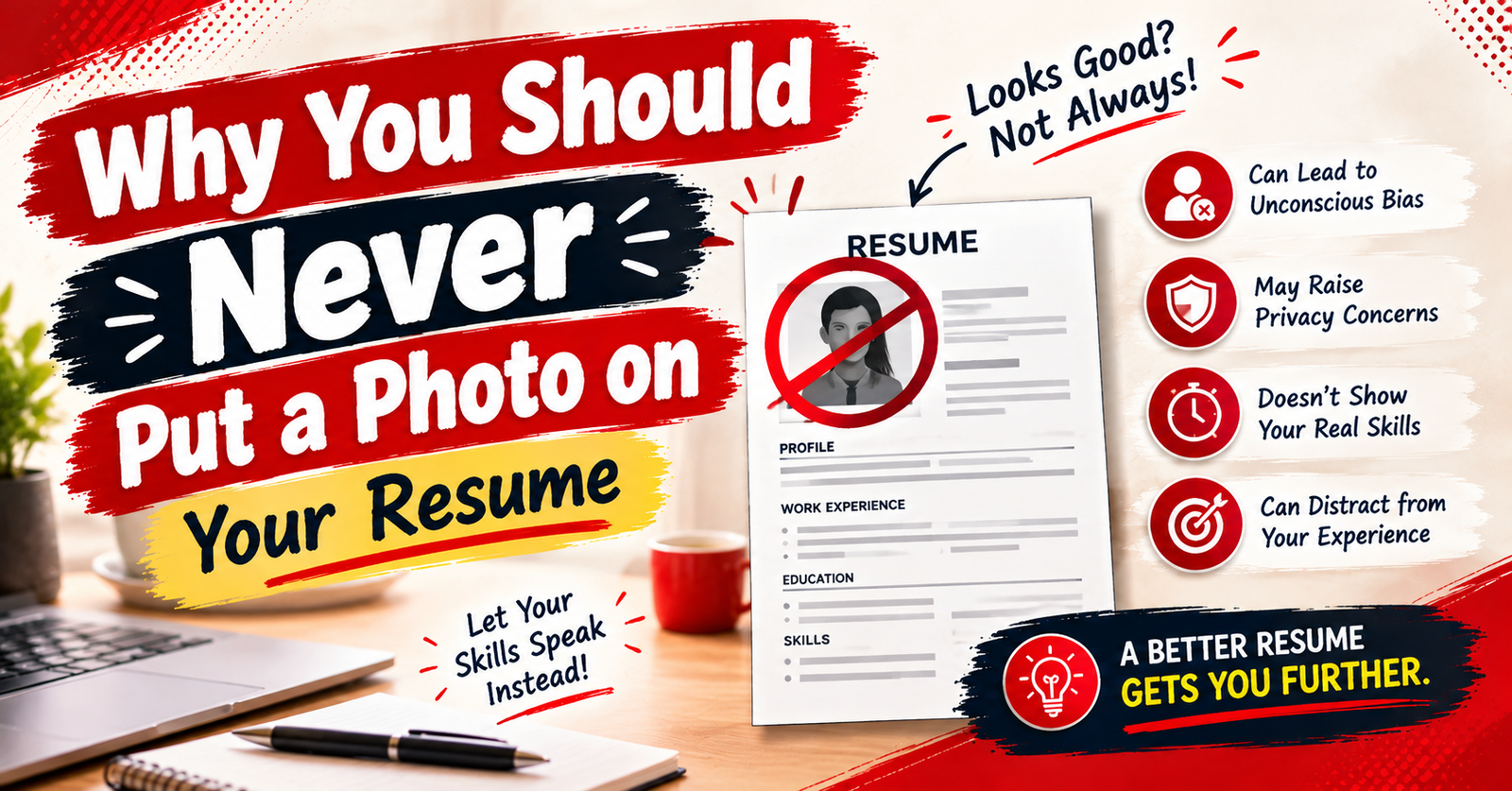
I used to think adding a photo made my resume look more "professional." Looked good in my head — a nice headshot in the corner, polished, put-together. Then a hiring manager friend of mine actually laughed when she saw it. Not in a mean way, more like, "oh, you still do that?" That one comment changed how I look at resumes completely.
Turns out, in a lot of places — especially if you're applying to companies in the US, UK, or any multinational — a photo on your resume isn't just unnecessary. It can actually work against you. I didn't believe it at first either. Felt almost counterintuitive, like, how could a photo possibly hurt me? But once you actually sit down and think through how recruiters and hiring software work, it starts making a lot more sense.
Let's go through this properly, one reason at a time.
1. It Opens the Door to Bias (Even Unintentional Bias)
Nobody wants to admit this, but it's true — the moment a recruiter sees your face, their brain starts making judgments. Age, race, weight, whether you "look tired," whether you "look like a good fit." None of this is fair, and most recruiters aren't doing it on purpose. It's not malicious most of the time. It's just how human brains work — we form snap impressions in milliseconds, long before logic kicks in.
This is exactly why so many companies that genuinely care about fair hiring practices will strip photos out of resumes before passing them to the hiring manager. Some go even further and anonymize names too, because names can carry the same kind of unconscious bias. If a company is actively removing something from your resume before it even gets reviewed, that should tell you something about whether it was helping you in the first place.
2. Legal Risk for the Company Hiring You
This part genuinely surprises people when I bring it up. In countries like the US, including a photo can actually create legal exposure for the employer, not you. Here's the logic — if they reject you, and you happen to be, say, over 40, or belong to a visible minority group, a photo on your resume makes it much harder for them to prove in court (if it ever came to that) that the rejection had absolutely nothing to do with how you look.
Because of this, a lot of HR departments have a blanket policy: resumes with photos get flagged, sometimes discarded automatically, or the candidate gets asked to resend a version without one. Either way, you've just added an extra step of friction that nobody asked you for, and in a hiring process where attention spans are already short, friction is the last thing you want.
3. ATS Software Doesn't Know What to Do With It
Most companies today — even smaller ones — run resumes through an ATS (applicant tracking system) before a human ever opens the file. These systems are built to parse plain text. Your name, your work history, your skills section, your education. That's what they're optimized for.
Images confuse them. Sometimes the photo file breaks the formatting entirely, pushes your actual content into weird columns, or just gets ignored while quietly eating up space that could've held one more line about something you actually accomplished.
| Resume Element | What ATS Typically Does With It |
|---|---|
| Plain text (skills, experience, education) | Reads and indexes it correctly |
| Photo | Often ignored entirely, sometimes breaks the layout |
| Fancy icons or graphics | Frequently causes parsing errors |
| Tables inside the resume itself | Can scramble the reading order completely |
| Headers/footers with contact info | Sometimes skipped by older ATS versions |
If you've ever wondered why a resume that looks gorgeous in Canva gets rejected before a human even sees it — this is usually why. The visual stuff that looks great to your eyes is often invisible, or actively harmful, to the software reading it first.
4. It Takes Up Space That Should Be Selling You
A resume photo usually eats up a good chunk of real estate — space that could instead hold one more bullet point about a result you delivered, a project you actually led, a number that proves your value in a way adjectives never will. Recruiters, on average, spend something like 6 to 7 seconds on that first resume scan. Maybe a little more if something catches their eye early.
Think about what that means practically. You've got a few seconds to prove you're worth a second look. Do you want that space occupied by a photo, or by the line that says you increased efficiency by 18% or led a cross-functional team through a product launch? The math isn't close.
5. It Can Look Outdated, Even If You Don't Mean It To
Photo-on-resume used to be the norm, especially a decade or two back, and it's still completely standard practice in some countries — parts of Europe, for instance, or certain Asian markets where it's practically expected. But in a lot of modern hiring, especially tech and corporate roles in English-speaking markets, it tends to read as a little old-fashioned.
It's not a dealbreaker by itself. Nobody's going to toss your resume just because of a photo alone. But combined with other dated habits — an "Objective" statement at the top, Times New Roman font, a fax number nobody's used since 2009 — it starts to paint a picture of someone who hasn't updated their approach in a while. And that impression, fair or not, matters.
So Where Should Your Photo Actually Go?
LinkedIn. Genuinely, that's really it. Your LinkedIn photo matters a lot more than people realize — recruiters absolutely judge that one, and it should look current, approachable, and professional. People form an opinion about your LinkedIn photo in roughly the same few seconds they'd glance at a resume, so it's not like photos don't matter anywhere. They just belong somewhere else.
| Where | Photo Needed? |
|---|---|
| Resume | No — leave it off |
| LinkedIn profile | Yes, and keep it recent |
| Portfolio website | Optional, depends on the field you're in |
| Modeling/acting resume (special case) | Yes, that's just how that industry works |
| Email signature | Optional, not a big deal either way |
A Few Exceptions Worth Knowing
Like most advice, this isn't a universal rule carved in stone. There are a handful of situations where it genuinely doesn't apply:
- Some countries — Germany, and parts of Asia in particular — still expect a photo on resumes, so it's worth checking local hiring norms before assuming the US/UK standard applies everywhere
- Creative industries like acting, modeling, or certain performance-based roles genuinely require a photo as part of the application
- If a job posting explicitly asks for a photo to be included, just follow the instruction, don't overthink it
- Internal company transfers sometimes use a slightly different, more relaxed format where a photo doesn't matter either way
Outside of those specific cases though, my honest take is just leave it off. Your resume has exactly one job — get you an interview. Let your actual work history do that heavy lifting, not your headshot.
What To Do Instead
If you're used to having a photo on your resume and now feel like something's missing without it, here's what to fill that space with instead:
- A short, specific summary line at the top — not a generic "hardworking professional seeking opportunities" line, but something that actually says what you do and what you're good at
- One more quantified achievement from your most recent role
- A skills section tailored to the actual job description you're applying for
- Extra white space — believe it or not, a resume that's slightly less cramped actually reads easier and looks more confident
None of these feel as visually exciting as a nice headshot, sure. But they're doing actual work for you, which is more than a photo can say.
Did you have a photo on your resume before? Curious whether it ever came up in an interview, good or bad — drop it in the comments.
Comments
No comments yet. Be the first to comment.