
If you live in Uttar Pradesh and have passed Class 12, this is one exam you should know about. The Uttar Pradesh Subordinate Services Selection Commission (UPSSSC) holds the Combined Lower Subordinate Services exam at the Intermediate (10+2) level to fill many Group C posts in different state departments, such as Amin, Storekeeper, Supervisor, Gram Panchayat Officer and Village Development Officer.
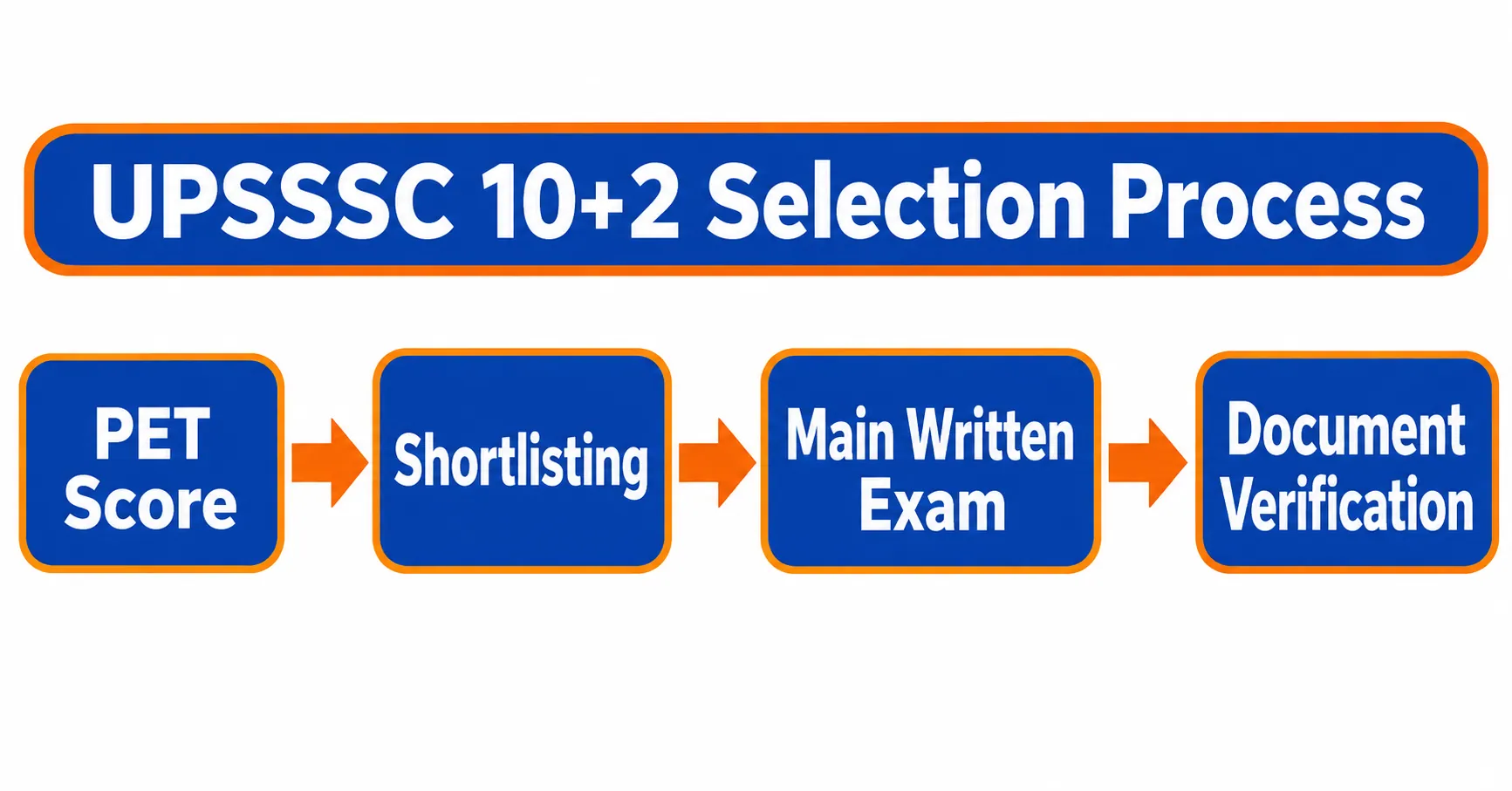
The exam works a little differently from most others. You do not walk straight into a big written paper. First comes a screening based on your PET score, and only then the main written exam. This guide explains that flow, the pattern of the paper, the syllabus, the salary and how to prepare for it without wasting time.
The details below follow the pattern seen in recent UPSSSC notices. Age limit, fee, posts and small rules can change from one notice to the next, so check the latest advertisement at upsssc.gov.in before you apply.
First, a quick picture of the exam
| Point | Details |
|---|---|
| Conducted by | Uttar Pradesh Subordinate Services Selection Commission (UPSSSC) |
| Level | Intermediate (10+2) |
| Type of posts | Group C posts in UP government departments |
| Screening | Shortlisting on the normalised PET score |
| Main exam | One objective paper, 100 questions, 100 marks, 2 hours |
| Negative marking | One-fourth (25%) of the marks of a question for each wrong answer |
| Interview | No |
| After the exam | Document verification |
UPSSSC also runs a separate Graduate level Combined Lower Subordinate Services exam (often called Lower PCS). This page is only about the 10+2 level one.
Why PET comes before everything else
PET means Preliminary Eligibility Test. UPSSSC uses it as a common first step for most of its recruitments. You give PET once, and the score you get is then used for the posts you apply for.
Here is how it connects to this exam:
- You must have appeared in the PET and received a valid score. If you never gave PET, you cannot apply for this recruitment.
- When the post notice comes, you apply online using your PET registration number.
- The Commission shortlists candidates for the main exam on the basis of the normalised PET score. Candidates with a zero or negative score are not shortlisted.
- Shortlisted candidates give the main written exam, and the final selection is made from it.
PET marks are not just a ticket. They decide whether you reach the main exam at all, so a weak PET score can cost you the chance even if you are good in the main paper.
Which posts come under this exam?
The posts are not the same in every notice. The commission picks the posts as the departments send their requirements. In recent notices the list has included the following.
| Post | Extra condition seen in recent notices |
|---|---|
| Commercial Tax Collection Amin | Intermediate pass |
| Land Acquisition Amin | Intermediate pass, preference to candidates with Lekhpal training |
| Storekeeper and Clerk | Intermediate pass |
| Assistant Cooperative Agriculture Supervisor | Intermediate pass |
| Housemother | Intermediate pass |
| Stenographer | Intermediate pass |
| Social Welfare Supervisor | Intermediate pass |
| Village Development Officer (Social Welfare) | Intermediate pass |
| Gram Panchayat Officer | Intermediate pass and a CCC certificate from NIELIT |
| Farm Clerk | Intermediate pass, 3 years of experience in agricultural work and working knowledge of Hindi in Devanagari script |
| Sales Clerk | Intermediate pass, 3 years of experience in sales work and working knowledge of Hindi in Devanagari script |
Notice that a few posts ask for something more than just 12th pass, like CCC or work experience. So do not select a post in the form only because it sounds good. Read its condition first.
Eligibility, in plain points
Qualification
You need to have passed the Intermediate (10+2) exam from the UP Board or an equivalent exam. The qualification should be complete by the last date given in the notice. Graduates can apply for these posts too, since 12th is the minimum, but check the notice to see how it treats higher qualifications.
Age limit
For most posts, recent notices have set the age at 18 to 40 years, counted as on a date given in the notice. Posts that need experience, like Farm Clerk and Sales Clerk, have had a tighter range of 21 to 30 years. Relaxation in the upper limit is given to reserved categories and some other groups as per UP government rules.
- SC, ST and other notified categories get relaxation as per state rules
- State government employees have got a 5 year relaxation in recent notices
- Ex-servicemen and outstanding sportspersons get relaxation under their own UP rules
Who gets the reservation
Reservation benefits are given only to the permanent residents of Uttar Pradesh. Candidates of other states are treated as Unreserved. EWS candidates need a valid EWS certificate of the financial year mentioned in the notice. For women candidates, the caste certificate made from the father’s side is accepted.
Date of birth
The date of birth written in your High School (Class 10) certificate is treated as final. If your PET form or any other record has a different date, fix that before you apply.
Application fee
The fee for the online application is very low. In recent notices it has been ₹25 for all categories, and correction of the form was free. Candidates who are shortlisted for the main exam pay a separate exam fee before they download the admit card.
The main exam: how the 100 marks are divided
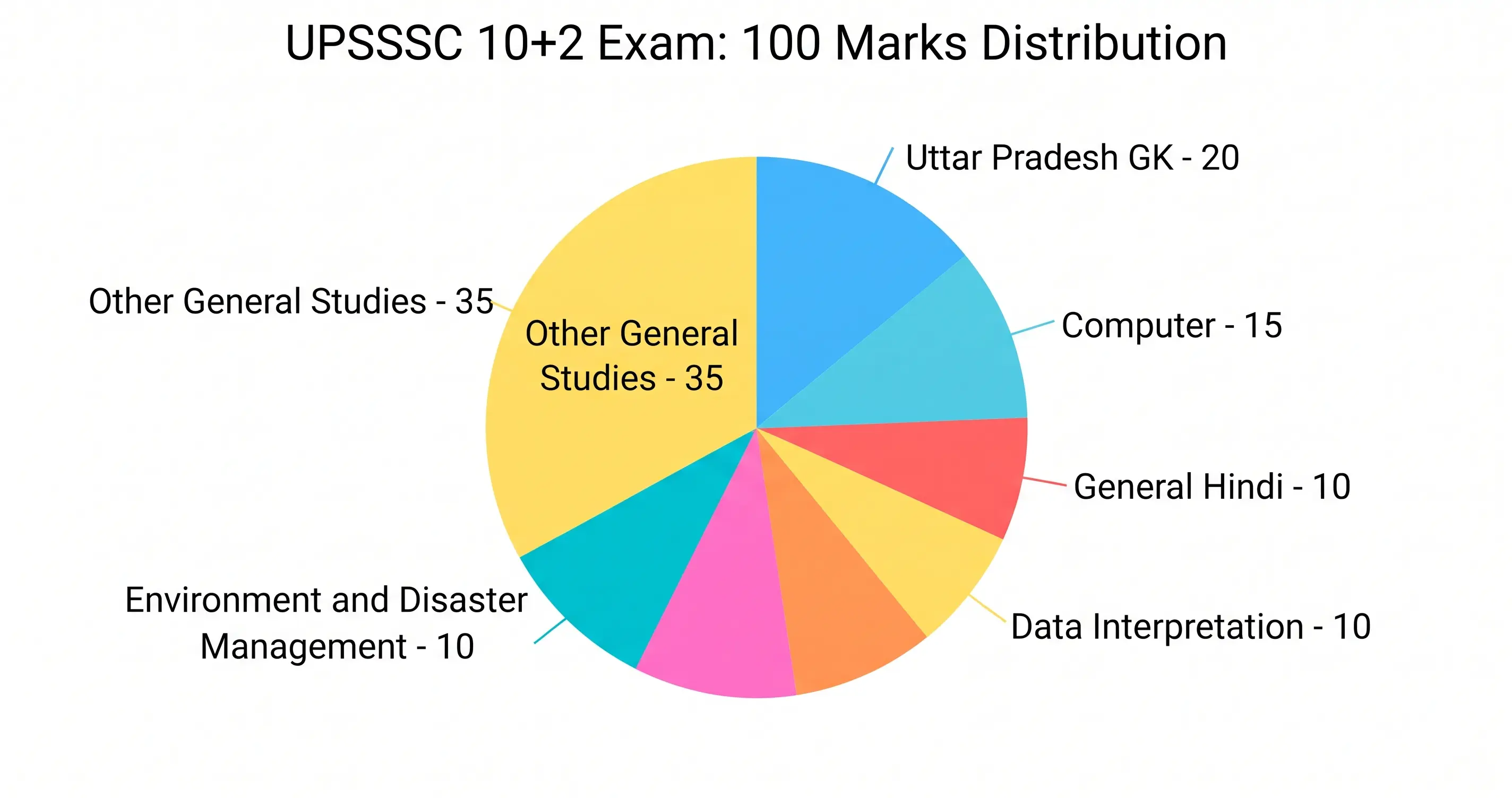
The paper is a single objective paper of 100 questions and 100 marks, with 2 hours to solve it. Every question carries 1 mark. The paper has three parts, and the table below shows how the marks are spread.
| Part | Subject | Questions | Marks |
|---|---|---|---|
| Part 1 | History of India and Indian National Movement | 5 | 5 |
| Part 1 | Indian Polity and Constitution | 5 | 5 |
| Part 1 | Geography of India and the World | 5 | 5 |
| Part 1 | Indian Economy and Social Development | 5 | 5 |
| Part 1 | Rural Society and Development | 5 | 5 |
| Part 1 | Current Events of National and International Importance | 5 | 5 |
| Part 1 | Science and Technology | 5 | 5 |
| Part 1 | Environmental Ecology and Disaster Management | 10 | 10 |
| Part 1 | Data Interpretation | 10 | 10 |
| Part 1 | General Hindi | 10 | 10 |
| Part 2 | Computer and Information Technology | 15 | 15 |
| Part 3 | General Information Related to Uttar Pradesh | 20 | 20 |
| Total | 100 | 100 |
In recent exams the paper has been given on an OMR sheet with pen. Your admit card will tell you the exact mode.
What this table is telling you
- Part 1 has 65 marks, but they are broken into ten small subjects, so no single subject can carry you
- Uttar Pradesh GK (20 marks) and Computer (15 marks) together are worth 35 marks, which is more than a third of the paper
- Data Interpretation and General Hindi are 10 marks each, and both are scoring if you practise
- Environment and Disaster Management has 10 marks, the same as Hindi, and is often skipped by students for no good reason
Negative marking, with numbers
For every wrong answer, one-fourth of the marks of that question is cut. Since each question is 1 mark, a wrong answer costs 0.25. Four wrong answers wipe out one correct answer. Unattempted questions carry no deduction, so a blind guess is not free. Guess only when you can remove at least two options.
Syllabus, part by part
Part 1: General knowledge and aptitude
- History of India and Indian National Movement: social, cultural, economic and political side of Indian history, and the freedom movement with the rise of nationalism
- Indian Polity and Constitution: constitutional development, the Constitution, political system and governance, Panchayati Raj, local self-government and public policy
- Geography of India and the World: physical, social and economic geography, agriculture, horticulture, forestry, animal husbandry, population, urbanisation, smart cities and smart villages, plus general world geography
- Indian Economy and Social Development: economic planning, NITI Aayog, Sustainable Development Goals, budget and financial system, agriculture, industry and trade, land reforms, effects of globalisation, and infrastructure like power, ports, roads, airports and railways
- Rural Society and Development: rural development programmes and schemes, rural health, rural social development, land reforms, and central and state schemes related to the village
- Current Events: important national and international events
- Science and Technology: science and technology policy in daily life, achievements of Indians, space, defence, energy, nanotechnology, biotechnology, and issues of intellectual property and digital rights
- Environmental Ecology and Disaster Management: ecosystem, wildlife, biodiversity, pollution, environmental impact assessment, climate change, the Disaster Management Act 2005, NDMA, SDMA, NDRF and SDRF
- Data Interpretation: reading tables, graphs and diagrams, and drawing conclusions from statistical data
Part 1: General Hindi
- Letters, office orders, notifications and circulars
- Pronunciation, writing, vowels, consonants and matras
- Sandhi and sandhi-viched, samas, prefixes and suffixes
- Tatsam, ardhatatsam, tadbhav, deshaj and foreign words, and the parts of speech
- Synonyms, antonyms, one-word substitution, homonyms, similar words and the right word choice
- Gender, number, person, tense, mood, aspect and voice
- Types of sentences, sentence purity and punctuation
- Idioms and proverbs
Part 2: Computer and Information Technology
- Computer basics, hardware and software
- Operating systems and common computer applications
- Internet, email and digital communication
- Word processing and spreadsheet applications
- Networking, digital platforms and information technology
- Cyber security, digital awareness and new technological developments
Part 3: General information about Uttar Pradesh
- History, culture, art, architecture, festivals, folk dances, literature and regional languages
- Geography, rivers, climate, soil, forests, wildlife, mines and minerals
- Economy, agriculture, industry, business and employment
- Polity, administration and state government schemes
- Tourism, monuments and important places
- Current events and recent achievements of the state
The detailed syllabus is attached with the official notice, so download it once and tick off topics as you finish them.
Salary
The posts under this exam have come under Level 2 and Level 3 of the 7th Pay Commission.
| Pay level | Pay scale |
|---|---|
| Level 2 | ₹19,900 to ₹63,200 |
| Level 3 | ₹21,700 to ₹69,100 |
The exact pay depends on the post, so look at the pay column of the post you choose in the notice. Allowances like DA and HRA are added to the basic pay as per the state government rates. Some posts are permanent and some are temporary, and the notice marks which is which, so check this before you select a post.
How to prepare: start from the marks, not from the books
With a 100 mark paper broken into twelve subjects, the smartest way is to decide your study time by marks and by how easy each subject is to score.
| Subject | Marks | How to approach it |
|---|---|---|
| General Information of Uttar Pradesh | 20 | Give this the most time. Read UP history, culture, rivers, districts, schemes and monuments, and make short notes for revision |
| Computer and IT | 15 | Learn basics, shortcut keys, MS Word and Excel, internet and cyber security. Most questions are direct |
| General Hindi | 10 | Revise grammar rules and word lists. Solve questions on sandhi, samas, synonyms and idioms daily |
| Data Interpretation | 10 | Practise tables, bar graphs and pie charts with a timer. Speed matters more than formulas here |
| Environment and Disaster Management | 10 | Cover pollution, biodiversity, climate change and the disaster management bodies. A few days of focused study can give most of these marks |
| History, Polity, Geography, Economy, Rural Development, Science, Current Events | 35 | Use NCERT books of Class 6 to 12 for basics. Add rural development schemes and keep a notebook for current affairs |
A simple 90 day plan
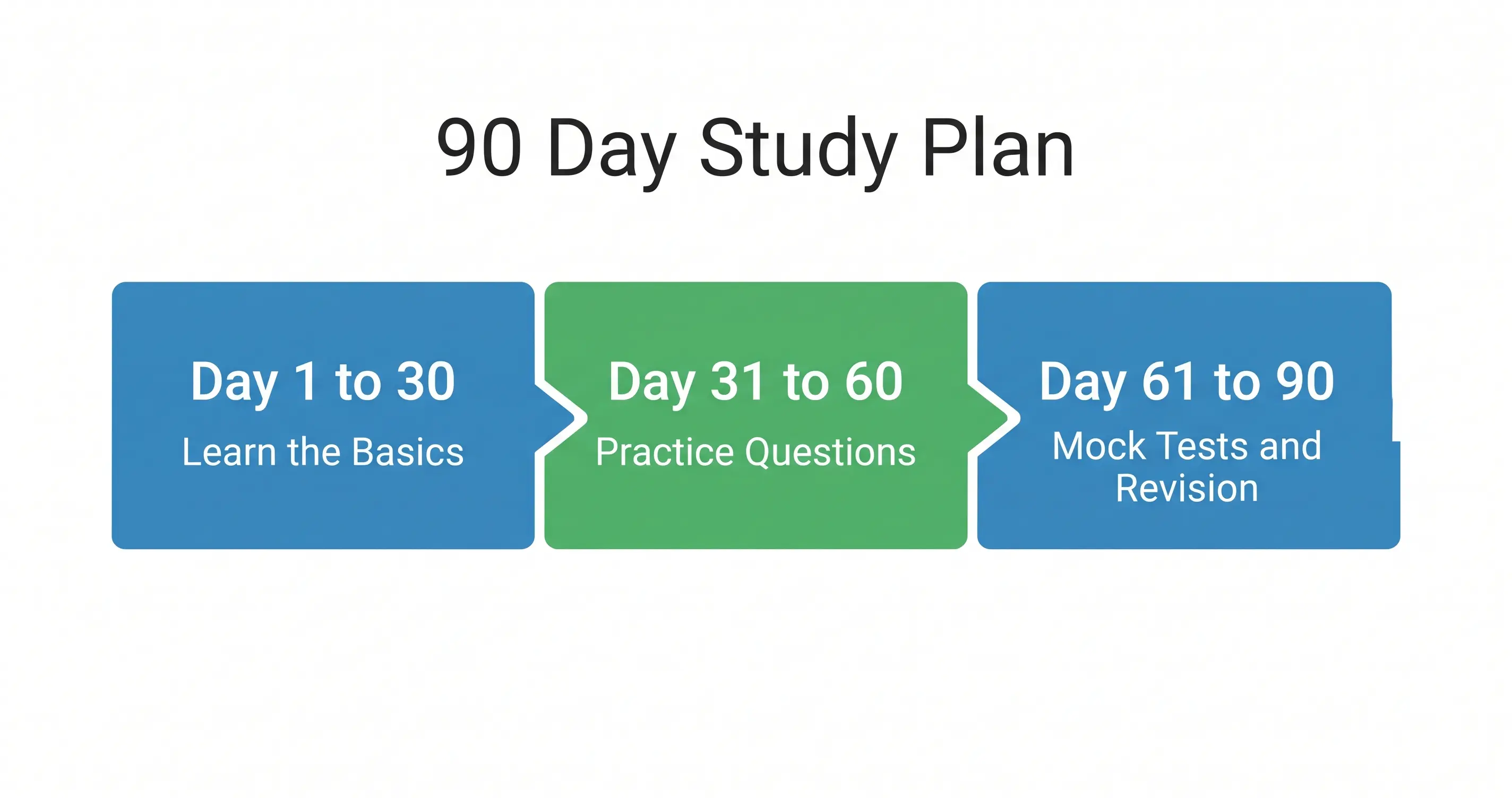
- Days 1 to 30: finish the basics of every subject once. Do not go deep yet. The aim is to see the whole syllabus.
- Days 31 to 60: go subject by subject with practice questions. Spend extra time on UP GK, Computer, Hindi and Data Interpretation.
- Days 61 to 90: take full length mocks of 100 questions in 2 hours, check every mistake and revise your short notes.
Do not forget PET. Its normalised score decides whether you are shortlisted, so a candidate who is also preparing for the next PET should not leave that preparation behind.
Handling the paper on exam day
Start with the parts you are most sure about, such as Hindi and Computer, and collect the safe marks first. Keep Data Interpretation for a calm stretch since it takes longer. Because of the 0.25 cut, mark an answer only when you are fairly confident. Keep the last ten minutes for checking the OMR sheet, since wrong bubbling is a loss that has nothing to do with knowledge.
Mistakes that quietly cost marks
- Skipping UP GK because it feels like too much to remember, when it carries the highest marks of any single subject
- Treating Computer as an easy 15 and not revising it even once
- Choosing a post without reading its extra condition, like CCC or experience
- Mismatch between the date of birth, name or category in the form and the documents
- Applying under a reserved category without a valid certificate, or as a non-UP resident
- Guessing too many questions and losing marks to negative marking
- Not practising the OMR sheet before the exam
UPSSSC Combined Lower Subordinate Services (10+2) Vacancy & Application Dates
Update (11 November 2026): UPSSSC has opened the online application under Advertisement No. 26-Exam/2026. The last date to apply and pay the fee is 1 December 2026, and corrections are allowed till 8 December 2026. The exam date has not been announced yet. Keep checking upsssc.gov.in for the admit card and the exam schedule.
| Event | Important Date / Link |
|---|---|
| Advertisement Number | 26-Exam/2026 |
| Total Vacancies | 1,784 |
| Notification Release Date | 16 October 2026 |
| Online Application Start Date | 10 November 2026 |
| Last Date to Apply Online | 1 December 2026 |
| Last Date for Fee Payment | 1 December 2026 |
| Application Correction Last Date | 8 December 2026 |
| UPSSSC Combined Lower Subordinate Services (10+2) Main Exam Date | Announce Soon |
| UPSSSC Combined Lower Subordinate Services (10+2) Recruitment Notification | View Notification |
| Apply Online | UPSSSC Apply Portal |
| Official Website | UPSSSC Official Website |
UPSSSC Combined Lower Subordinate Services 10+2 Level Free Study Material & PDF Books
Prepare for the UPSSSC Combined Lower Subordinate Services 10+2 Level Examination with free subject-wise PDF study materials from ResumeSathi. Download Uttar Pradesh GK, Computer Knowledge, General Hindi and General Studies MCQ PDFs to practise important exam-oriented questions, improve your subject knowledge and strengthen your preparation. Each PDF includes practice questions with answers and explanations.
UPSSSC Uttar Pradesh General Knowledge (UP GK) MCQ PDF
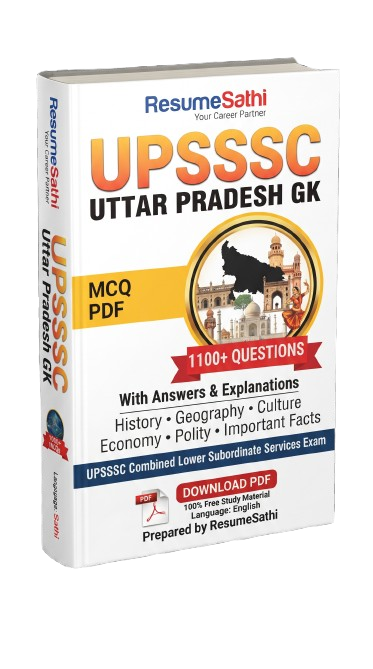
Uttar Pradesh GK MCQ PDF
Prepare with important Uttar Pradesh General Knowledge questions covering UP history, geography, culture, economy, polity, districts, rivers and other state-specific topics, with answers and explanations.
Subject: Uttar Pradesh GK Download UP GK MCQ PDFUPSSSC Computer Knowledge MCQ PDF
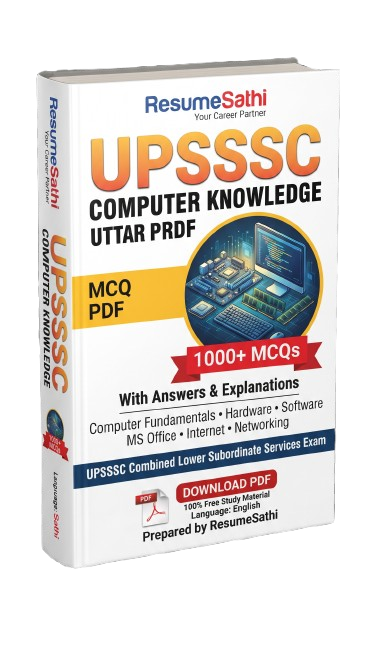
Computer Knowledge MCQ PDF
Practise important Computer Knowledge MCQs covering computer fundamentals, hardware, software, operating systems, MS Office, internet, networking and information technology, with answers and explanations.
Subject: Computer Knowledge Download Computer MCQ PDFUPSSSC General Hindi & General Studies MCQ PDFs
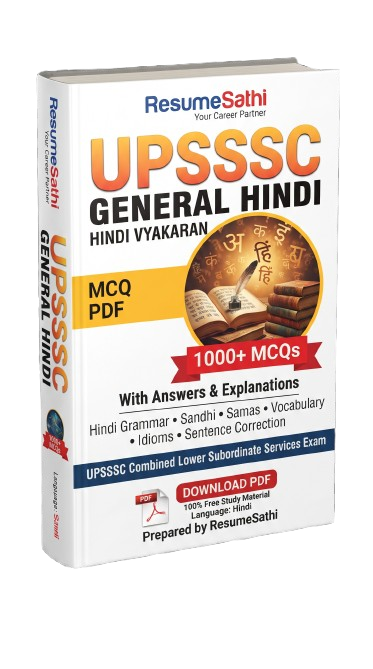
General Hindi MCQ PDF
Strengthen your Hindi preparation with important General Hindi MCQs covering Hindi grammar, Sandhi, Samas, synonyms, antonyms, vocabulary, idioms, sentence correction and other essential topics, with answers and explanations.
Subject: General Hindi Download General Hindi PDF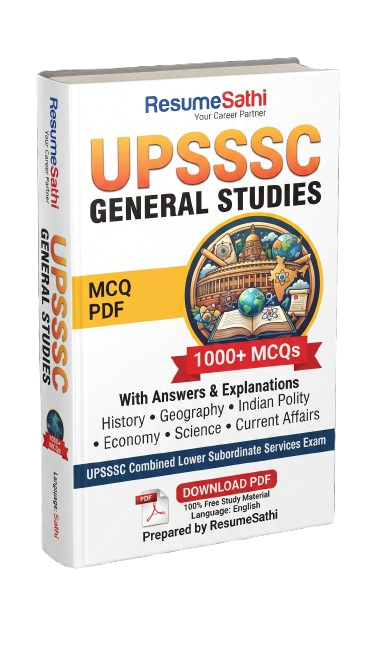
General Studies MCQ PDF
Prepare for General Studies with practice MCQs on Indian History, Geography, Indian Polity, Economy, General Science, Environment, Current Affairs and other important topics, with answers and explanations.
Subject: General Studies Download General Studies PDFQuestions people ask
Is PET compulsory for this exam?
Yes. You must have appeared in the PET and have a valid score. Shortlisting for the main exam is done on the normalised PET score, and candidates with a zero or negative score are not shortlisted.
Can graduates apply for the 10+2 level posts?
12th pass is the minimum qualification, so graduates can usually apply too. Check the notice for the exact rule and for any extra condition of the post.
Is there an interview?
No. The main written exam decides the merit, and it is followed by document verification.
How many questions come in the main exam?
There are 100 objective questions for 100 marks, and the time given is 2 hours.
Is there negative marking?
Yes. One-fourth of the marks of the question is cut for each wrong answer. For a 1 mark question this is 0.25.
Which subject has the most marks?
General Information of Uttar Pradesh has 20 marks, which is the highest for any single subject. Computer comes next with 15 marks.
Is the syllabus the same for 10+2 and graduate level?
No. Both levels have separate notices and the pattern is not the same. For example, the 10+2 level paper has smaller sections for History, Geography, Polity and Economy, while the graduate level has different weight for some subjects. Always follow the syllabus of the level you are applying for.
What is the age limit?
In recent notices it has been 18 to 40 years for most posts, with a tighter range of 21 to 30 years for posts that need experience. Relaxation is given as per UP government rules.
Do I need to be a resident of Uttar Pradesh?
Reservation benefits are for permanent residents of Uttar Pradesh only. Candidates from other states are treated as Unreserved, as per recent notices.
Do I need CCC or any computer certificate?
Only for some posts. In recent notices, the Gram Panchayat Officer post has asked for a CCC certificate from NIELIT. Most other posts have not, but the Computer part of the paper is there for everyone.
How long does preparation take?
If you start from the basics, around three months of steady daily study is a fair target. If you are also preparing for PET at the same time, plan for more.
Where can I get free PDF books?
Buy UPSSSC Combined book Now : Click Here

Comments
No comments yet. Be the first to comment.