
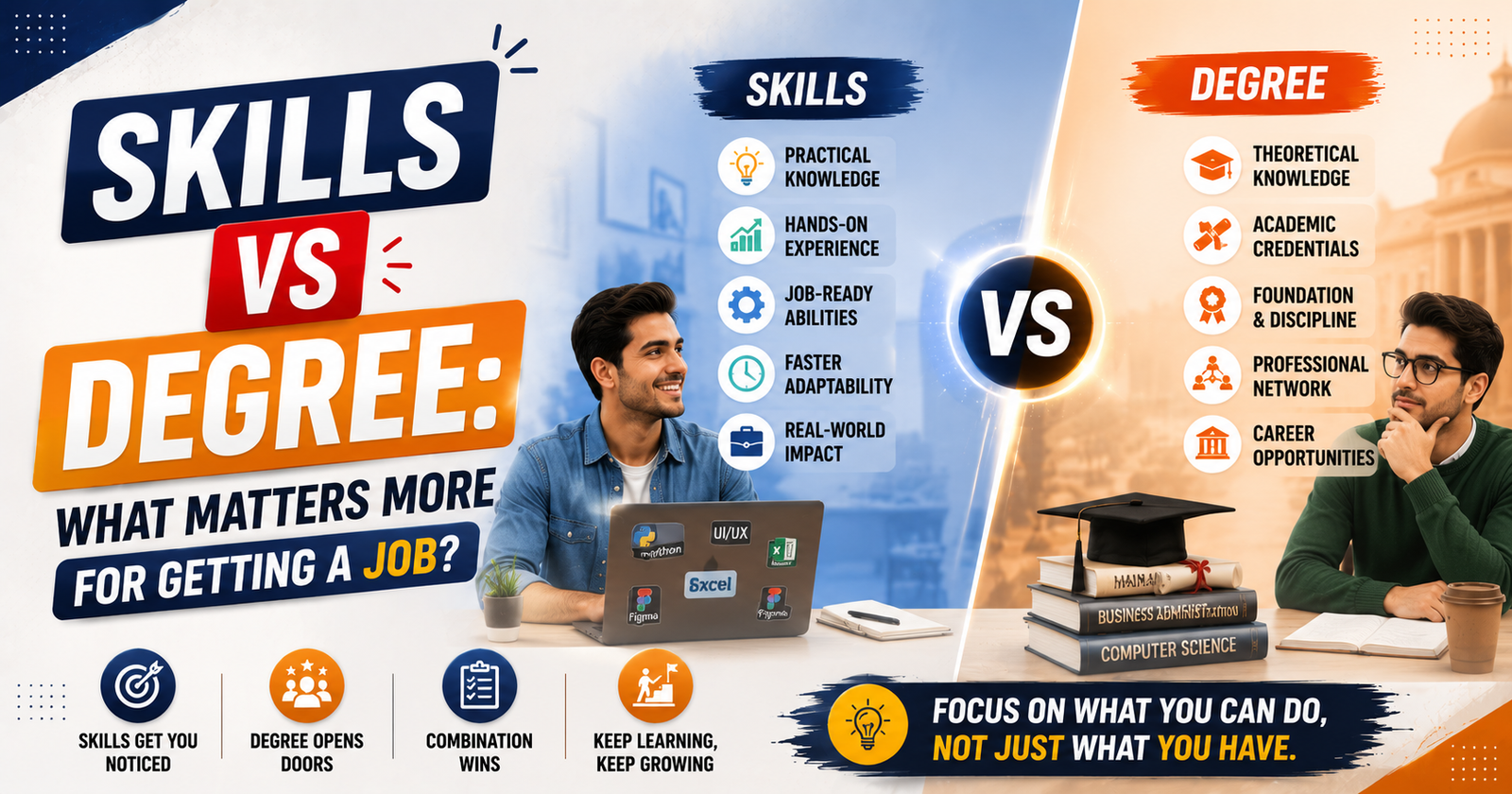
Somebody asked me this the other day, half joking — "should I just drop out and learn to code instead?" I didn't have a one-line answer for them, and honestly, nobody really does. The truth sits somewhere in between, and it depends a lot more on the industry, the role, and the actual person than most advice online admits.
Still, it's worth pulling apart properly, because this question isn't going away. If anything, it's coming up more often now that self-taught developers, bootcamp grads, and certificate-holders are landing roles that used to require a specific degree on paper.
Why This Debate Even Exists
A degree used to be the default filter. No degree, no interview — that was pretty much it for a long time. But a few things have shifted that:
- Tech and creative fields grew fast enough that formal education couldn't keep up with what the job actually required
- Free and low-cost learning resources made it possible to build real skills outside a classroom
- Portfolios, GitHub profiles, and project work started speaking louder than a transcript in a lot of hiring conversations
- Some companies quietly removed degree requirements from job postings, especially for technical roles
That said, this shift hasn't touched every industry equally, which is really the whole point of this post.
Where Skills Tend to Win
In some fields, what you can actually do outweighs what your certificate says, and it's not close.
| Field | Why Skills Matter More Here |
|---|---|
| Software Development | Employers usually just want to see working code, a portfolio, or GitHub activity |
| Digital Marketing | Results from past campaigns say more than a marketing degree ever could |
| Graphic / UI Design | A strong portfolio does the talking, formal design education is a bonus at best |
| Freelancing / Content Creation | Clients care about output and reliability, not where you studied |
| Sales | Track record and communication ability matter far more than qualifications on paper |
Where a Degree Still Carries Real Weight
On the flip side, there are fields where skipping a degree basically closes the door before you even apply.
| Field | Why the Degree Still Matters |
|---|---|
| Medicine | Legally required, no shortcut exists here regardless of skill level |
| Law | Licensing and bar exams are tied directly to formal education |
| Government Jobs | Eligibility criteria are usually degree-based by default |
| Core Engineering (Civil, Mechanical) | Safety-critical work often requires certified, degree-backed knowledge |
| Academic / Research Roles | Degrees are essentially the entry ticket, sometimes multiple of them |
What Recruiters Are Actually Looking At
I've heard enough hiring managers talk about this to notice a pattern — most of them aren't choosing one over the other, they're weighing both against the role in front of them.
| Hiring Factor | What It Signals |
|---|---|
| Relevant Skills | Can this person do the job on day one, or close to it |
| Degree | Baseline discipline, foundational knowledge, sometimes just a filtering tool for large applicant pools |
| Portfolio / Past Work | Proof over promises, this often overrides both of the above |
| Certifications | A middle ground — shows initiative without needing four years |
| Interview Performance | Can override a weak resume on either side entirely |
So What Should You Actually Do?
This isn't really a "pick one" situation, no matter how the question gets framed online. A few honest points worth considering:
- If you're aiming for a licensed profession, there's no getting around the degree, plan around that reality
- If you're going into a skill-driven field, put your energy into building something you can actually show, not just certificates you can list
- A degree plus strong skills will almost always beat either one alone, this isn't an either-or as often as people think
- If you already have a degree in an unrelated field, don't assume it's wasted, transferable skills count more than people give them credit for
- Whatever path you're on, keep building a portfolio, work samples convince people faster than any qualification does
Where I'd Land On This
Neither skills nor a degree wins this argument outright, and honestly, anyone who tells you it's a clean answer is probably trying to sell you something. What actually gets you hired is being useful for the specific role you're applying for. Sometimes that means a degree. Sometimes it means a portfolio and a willingness to prove yourself in the interview. Most of the time, it's a mix of both, plus a bit of timing and effort that no chart can really capture.

Comments
No comments yet. Be the first to comment.