
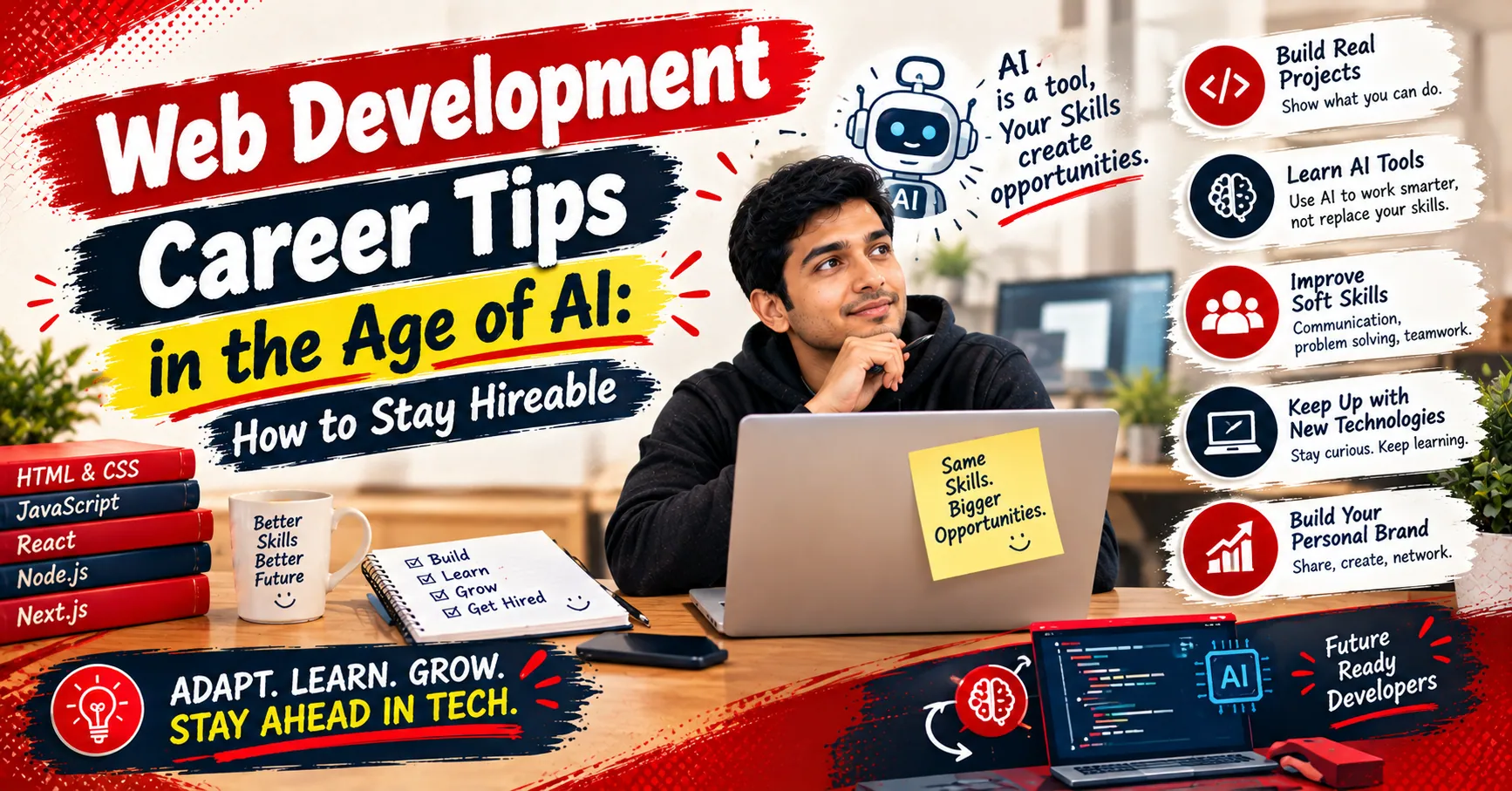
A junior developer I know messaged me a few months ago, kind of panicked. He'd just watched an AI tool build a full landing page, responsive layout and all, in about forty seconds. The same thing that took him two days when he was learning. His question was simple, and a little heartbreaking: "Is there even any point in learning web development anymore?"
I get why people feel this way. Every other week there's a headline about AI replacing coders, and entry-level hiring has genuinely become tougher in a lot of places. But here's my honest take after watching this space for a while: web development isn't dying. What's dying is a very specific version of it, the version where you only copy patterns, only build basic pages, and never really understand what's happening underneath.
So if you're a student, a fresher, or even a few years into your career and feeling nervous, here's what I'd actually do.
First, Let's Be Honest About What's Changing
No point pretending nothing has shifted. Some work that used to be a junior developer's bread and butter is now partly automated. Simple static sites, boilerplate code, basic CRUD screens, repetitive component building. AI handles a lot of that quickly now, and companies have noticed.
| Work AI Is Getting Good At | Work Still Needing Real Humans |
|---|---|
| Boilerplate and repetitive code | Understanding messy business requirements |
| Simple landing pages and layouts | System design and architecture decisions |
| Basic bug fixes and syntax errors | Debugging weird, multi-layered production issues |
| Generating first-draft components | Performance, security, and scalability trade-offs |
| Writing standard documentation | Talking to clients, stakeholders, and other teams |
Look at the right column. Almost none of it is about typing code faster. It's about judgment, context, and communication, which is exactly where you should be aiming.
1. Learn Fundamentals Deeply, Not Just Frameworks
Here's a trap I see constantly. People rush through a React or Next.js tutorial, build a clone project, and call themselves ready. Then an interviewer asks how the browser actually renders a page, or why a certain bug happens, and there's just silence.
AI can generate framework code all day. What it can't do for you is understand when that code is wrong, slow, or insecure. And someone needs to be able to tell the difference. That someone is you, but only if your fundamentals are solid.
- Get properly comfortable with JavaScript itself, not just libraries built on top of it
- Understand how HTTP, APIs, cookies, and browsers actually work
- Learn basic data structures and how databases handle queries
- Know enough CSS to fix a layout without asking a tool every single time
2. Use AI as a Tool, Not a Crutch
Developers who refuse to touch AI are going to fall behind, honestly. But developers who let AI do all their thinking are in just as much danger, maybe more. The ones doing well right now are using AI the way a good carpenter uses a power tool: faster, but still fully in control of what's being built.
| Healthy Way to Use AI | Risky Way to Use AI |
|---|---|
| Ask it to explain code you don't understand, then verify | Paste generated code without reading it |
| Use it to speed up repetitive tasks | Use it to avoid learning core concepts |
| Review and improve its suggestions | Trust output blindly because it "looks right" |
| Brainstorm approaches, then decide yourself | Let it make every architecture decision |
3. Move From "Coder" Toward "Problem Solver"
Companies don't actually want code. They want problems solved: customers retained, pages loading faster, checkout flows converting better. Code is just the means. Developers who understand the business reason behind what they're building tend to be much harder to replace, because that understanding isn't something you can prompt your way into.
Next time you get a task, ask why it exists. Who's using this? What happens if it breaks? What would make it genuinely better, not just technically finished? That mindset sets you apart faster than adding another framework to your resume.
4. Specialize, Because Generalists Get Squeezed First
Being decent at everything used to be fine. Right now, "I can build a basic website" is the exact thing getting commoditized. Having depth in something specific gives you a real edge.
- Performance optimization: making sites genuinely fast, which directly affects revenue
- Accessibility: still badly neglected, increasingly required by law in many places
- Security: AI-generated code often has quiet vulnerabilities, so people who catch them are valuable
- E-commerce or fintech platforms: domains with real complexity and real money on the line
- Backend and system design: deeper work that's harder to automate end to end
- Integrating AI features into products: companies need people who can build with AI, not just worry about it
5. Build Real Projects, Not Tutorial Clones
Recruiters have seen the same to-do app, weather app, and Netflix clone hundreds of times. They tell them nothing. What stands out is a project that solves an actual problem, even a small one, with real users, real messy edge cases, and real decisions you can talk about.
Build something for a local shop, a friend's side business, or a community you're part of. Deal with actual feedback. Then you've got a story to tell in interviews, and stories are far more convincing than a GitHub full of copied repos.
6. Don't Ignore Soft Skills, They're Doing More Work Than You Think
This sounds boring, I know. But as basic coding gets easier, the gap between developers is increasingly about communication: explaining a technical trade-off to a non-technical manager, writing a clear pull request, pushing back politely when a request doesn't make sense. Those skills compound over a career in a way that syntax knowledge simply doesn't.
7. Keep Learning, But Pick Your Battles
New tools appear every week. You cannot chase all of them and you shouldn't try. A smarter approach is picking one or two directions that match where you want to go, going deep, and just staying loosely aware of everything else.
| Stage | What to Focus On |
|---|---|
| Beginner | HTML, CSS, JavaScript fundamentals, Git, basic projects |
| Early career | One framework properly, APIs, databases, deployment basics |
| Mid-level | System design, performance, testing, mentoring others |
| Senior | Architecture, decision-making, leading teams, business impact |
8. Build a Visible Presence Beyond Your Resume
When applicant volume is high, being a known name helps. Write about something you figured out. Share a small project. Contribute to an open-source repo, even something minor like fixing documentation. It doesn't need to be impressive, just genuine and consistent. Over time people start recognizing your name, and that opens doors that applications alone often don't.
A Realistic Way to Look at All This
Will some roles shrink? Probably, yes. Will the job look different in five years than it does today? Almost certainly. But every big shift in tech, from the rise of high-level languages to cloud computing to frameworks, was supposed to make developers obsolete, and instead it changed what developers do. The people who adapted did fine, often better than before.
The real risk isn't AI itself. It's staying at the surface level and hoping nothing changes. If you're willing to go deeper, solve real problems, and keep adapting, there's still plenty of room in this field.
Are you worried about AI affecting your development career, or has it actually helped you work faster? Would love to hear your honest experience in the comments.



Comments
No comments yet. Be the first to comment.