
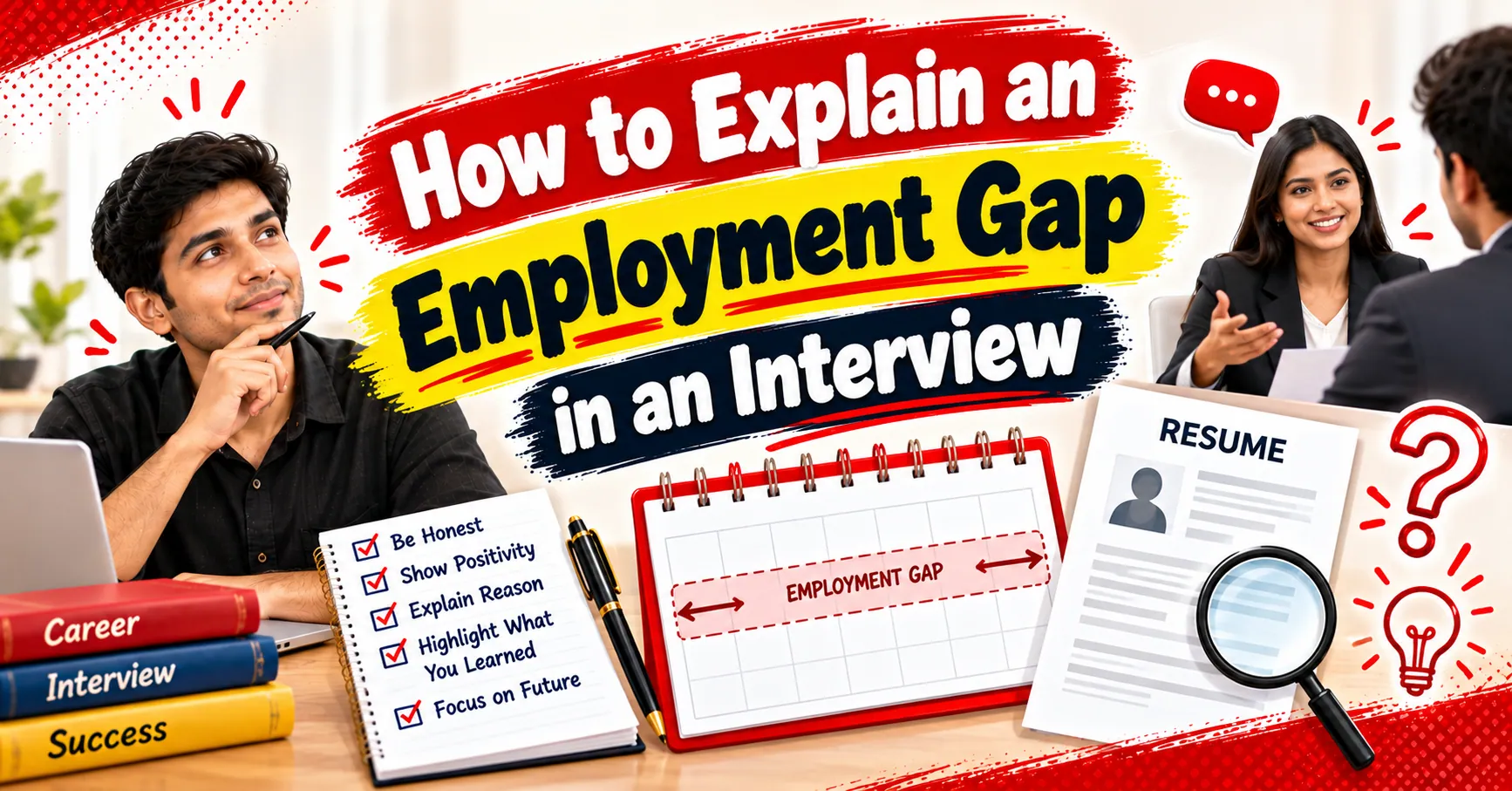
My neighbour's sister took almost two years off when her father had surgery and needed full-time care. When she finally started applying again, she told me the gap on her resume was all she could think about. Every night before an interview she'd practise some long, apologetic speech in front of the mirror. In her first interview she talked about it for nearly three minutes, said "sorry" at least twice, and walked out feeling like she'd confessed to something. She hadn't done anything wrong. Nobody had ever shown her how to say it.
If you've got a gap, you're in far bigger company than you'd guess. Layoffs, illness, a baby, a parent who needed looking after, a business that didn't work out, a job hunt that dragged on way longer than planned, plain old burnout. Interviewers have heard every version. Most of them aren't even bothered by the gap itself. What they notice is how you handle talking about it.
Why they ask in the first place
It feels like an accusation when it comes up, but usually it isn't. They're just trying to fill in a blank. Was there something that might affect the job? Did you stay somewhat connected to your field? Are you ready to work now? And, quietly, are you honest with them? A gap explained calmly looks much better than one you try to hide or dress up, which is why people who dodge the question tend to do worse than people who just answer it.
A simple shape for your answer
Nearly every good answer I've heard follows the same rough pattern, and it takes maybe 30 to 45 seconds out loud. If it's going past a minute, you're explaining too much.
| Part | What it does | Example |
|---|---|---|
| Say it | One plain sentence about what happened | "I took a year off to look after a family member." |
| Show you kept up | Anything you did to stay in touch with your field | "I also finished a short course in data analysis." |
| Turn to the job | Why you're ready and why this role | "I'm ready to come back full time, and this role is exactly what I want to do next." |
See what's missing? No backstory, no guilt, no "unfortunately." You give the fact, you show you're still sharp, and then you steer back to the work. That's the whole trick, honestly.
What it might sound like
Please don't memorise these. The second someone asks a follow-up, a memorised answer falls apart and you'll sound like you're reading from a card. Take the rough idea and say it the way you'd say it to a friend.
| Reason | Something like this |
|---|---|
| Layoff or shutdown | "My company restructured and my whole team was let go. I used the time to get better at Excel and Power BI, and I've been focused on roles like this since." |
| Family responsibilities | "I took time off to care for someone in my family. That's sorted now and I'm ready to commit fully to a new role." |
| Health | "I took a break for a health issue. I'm completely fine now, and I kept reading up on what's changing in the field while I was away." |
| Long job search | "The market was slow in my area so I was picky. I did some freelance work and a certification meanwhile, and this role stood out to me." |
| Exam preparation | "I spent time preparing for a competitive exam. It didn't go the way I'd hoped, but I'm clear now about what I want from my career." |
| Relocation | "I moved cities with my family and needed time to settle in. We're settled now and I'm looking for something long-term here." |
| Burnout or planned break | "After a few very intense years I took a planned break. I came back with a clearer head about what I want." |
| Own business closed | "I tried building my own venture. It didn't scale as we hoped, but I handled sales, operations and hiring, and that's what I'd bring to this job." |
| Parenting break | "I stepped away to raise my child in the early years. I'm ready to return full time and I've been refreshing my skills for it." |
How much should you actually tell them?
Less than you think. You're allowed to keep private things private. If it was a health scare, a family problem or something painful, nobody is owed the whole story. "A personal health matter, completely resolved now" is enough. And if they dig, you can say something like "it was a private matter, but I can assure you it won't affect my work." Most interviewers will nod and move on, because the good ones don't want to pry either.
Fix what you can before you walk in
If the gap is recent, there's still time to put something into it. A short online course, some freelance work, a bit of volunteering, a project you build for yourself. None of it has to be impressive. It just needs to be real, and it gives you something to say in step two of the answer above.
Also, reach out to people you used to work with. A referral from someone who's seen your work makes the gap shrink in the interviewer's eyes, sometimes to almost nothing. And read up on what changed in your field while you were away, so you don't sound out of touch when they ask. Then say your answer out loud a few times, in the shower, on a walk, wherever. It sounds silly but it helps more than writing it down.
What to do on the resume
People forget the resume is where the gap gets noticed first, usually before you've said a word.
| Better | Worse |
|---|---|
| Years only (2021 to 2023) when the gap is a few months | Changing dates to hide it |
| A one-line entry like "Career break: family care" for longer gaps | Leaving a big blank with no explanation |
| Listing freelance work, courses or volunteering from that period | Inventing projects or a fake job |
| A hybrid or skills-first layout if the gap is large | Spending half the page apologising for it |
A gap of a few months rarely needs any explanation on paper. A year or more is better stated in one short line so the recruiter isn't left guessing.
Things to avoid saying
Don't run down your old boss or company, even if they were awful. It makes you look bitter, and the interviewer starts wondering what they'd hear about you someday. Don't invent a job either. Background checks and reference calls catch this more often than people expect, and it's the one thing that can actually end an offer. Skip the heavy apologies too, and don't blame the economy as your entire answer.
And if the real reason was something like "I just needed a break and didn't feel like working," say it in a more honest, useful way: you were burnt out, you took time to recover, and you're back with energy now. It's the same truth, just told like an adult.
When the follow-up questions come
They sometimes do. "Why didn't you look for work earlier?" "Did you keep your skills up?" "How do we know you won't leave again?" Stay calm, keep each answer short, and don't get defensive. For the last one, you don't have to make big promises. Something like "I'm settled and I'm looking for a role where I can grow for a good while" sounds honest and is believable. Then, if you can, pull the conversation back to what you'd do in this job.
About confidence
Here's what I've noticed over the years. Most of the awkwardness around a gap comes from the person who has it, not the one asking. If you treat it like something shameful, the interviewer picks up on that and starts wondering what's behind it. If you say it plainly, in a normal voice, and carry on to your skills, they usually just carry on too. A career is a long story. A pause in the middle of it isn't a plot hole.
Before the interview, quickly
- A 30 to 45 second answer, in your own words
- Reason, proof you stayed sharp, then the future
- Practised out loud at least a couple of times
- A resume that shows the gap honestly
- A decision on which private details you'll keep to yourself
Have you ever had to explain a gap in an interview? Tell me how it went in the comments, someone reading might be dreading the same question right now.

Comments
No comments yet. Be the first to comment.