
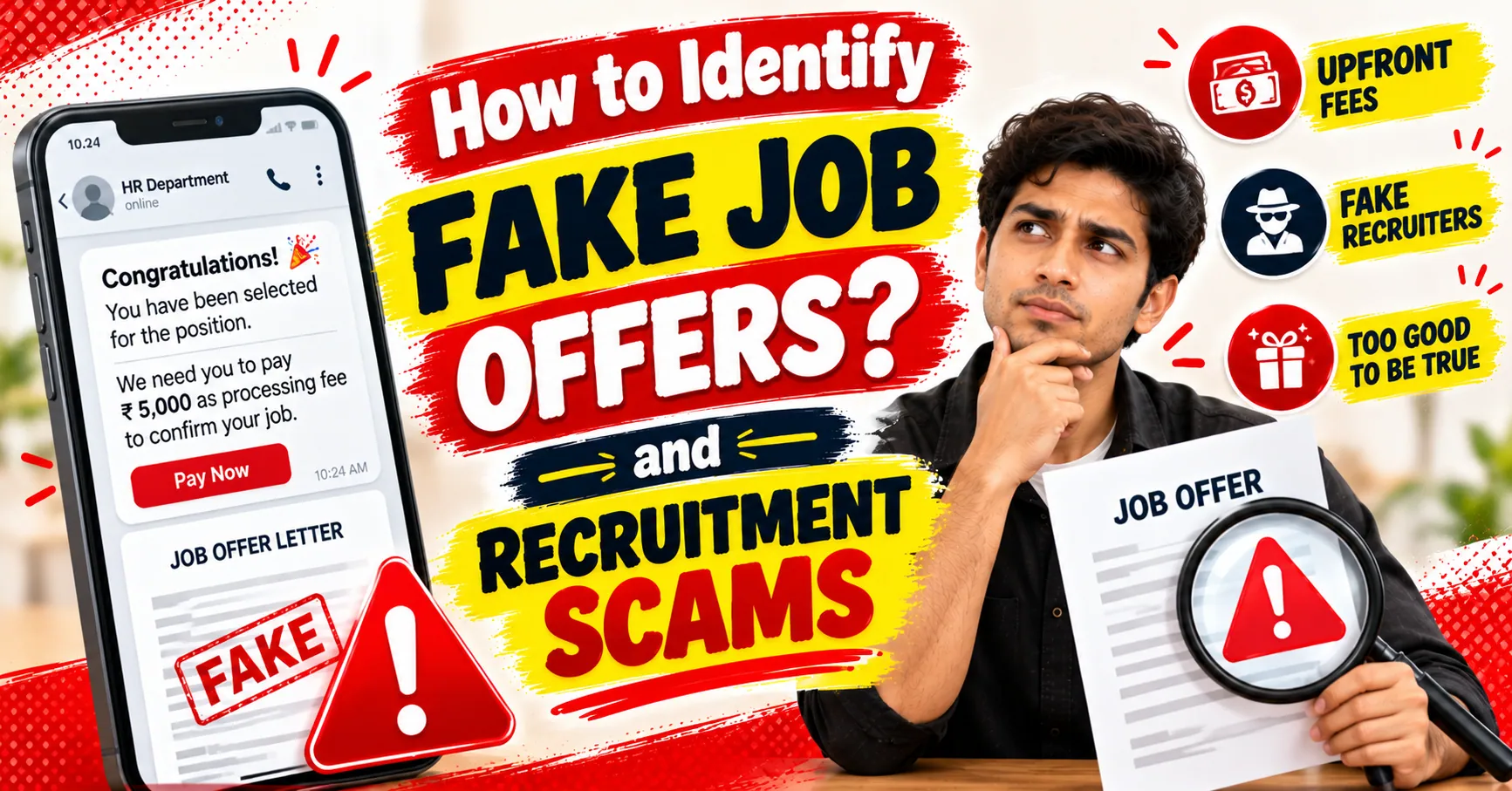
There's a boy in my building, just out of college, who was desperate for his first job like most of us were at that age. One evening he got a WhatsApp message from a "recruiter" at some big-sounding company. His resume had been shortlisted, apparently. A chat interview, an offer letter two days later, and a salary nearly double what freshers normally get. The only small thing was a refundable "security deposit" of a few thousand rupees, to block his seat. He paid it. After that the number stopped replying, the email on the offer letter bounced, and the real HR of that company told him they'd never heard of him.
He lost the money, sure. But he told me later that what hurt more was the two weeks he'd spent feeling like his life had finally started. That part you can't get refunded.
Fake job offers are everywhere now, mostly because they hit people at exactly the wrong moment, when they badly need a job and want to believe. The scammers have also improved. The logos look right, the letters look right, even the language is polished. The good news is that most of the signs are easy to see once someone points them out, so let's go through them.
If they ask for money, stop
This is the one rule I'd tattoo on every job seeker's hand. A real employer pays you. They don't charge you. Registration fee, training kit, laptop deposit, "background verification charges," refundable security money, visa processing, insurance. Different names, same scam. Companies cover their own hiring costs, and if a background check is needed, they pay for it.
There's one small grey area, which is training or placement institutes that charge for an actual course. But that's a separate, clearly stated service, not a "job offer" with a fee stuck on the front. If someone calls it an offer and wants money before you've drawn a single salary, walk away.
The smaller signs
Scams rarely depend on one trick. It's usually a pile of small things that look okay on their own and feel wrong together.
| What you notice | Why it bothers me |
|---|---|
| You never applied but they say you're shortlisted | Could be a genuine cold message on LinkedIn, but check the profile properly before replying |
| The whole interview happens on WhatsApp or Telegram chat | Real hiring almost always has a call or video round with a named person |
| The offer arrives in a day or two with hardly any questions | Companies compare candidates, and that takes time |
| Salary is way above market for your experience | It's bait. Plain and simple |
| Email comes from Gmail, Yahoo or Outlook | HR teams use the company's own domain |
| Job description is vague, no real role or team | Copy-pasted text, because there's no actual job behind it |
| "Pay today or the seat goes" | Urgency is there to stop you from thinking |
| Spelling mistakes in the offer letter | Official letters usually get proofread |
| Early requests for Aadhaar, PAN, bank details or OTP | That info is collected after joining, through proper channels |
| "Work from home, earn per task" | A very common scam format, more on it below |
The "like and earn" trap
This one has caught plenty of educated, careful people, so don't feel clever about being immune. A message offers part-time work: like videos, rate hotels, boost reviews, finish small tasks. The first few tasks actually pay you, a small amount, and that's the hook. It builds trust. Then you're added to a group, and the next tasks supposedly need you to deposit money to unlock bigger rewards. You pay, they ask for more, and eventually both the money and the contact vanish.
The giveaway is simple. If you're paid for tasks that create no real value for any business, and then asked to put money in, it's a scam. Nobody who genuinely wants to give you work needs your money first.
Checking whether it's real
You don't have to play detective. A few minutes of checking catches most of these.
| Check | How |
|---|---|
| Company website | Type the address yourself in the browser. Don't click the link in the message. |
| Email domain | Should match the company's own domain. Look closely for tiny changes like an extra letter or a hyphen. |
| Careers page | A real company hiring usually lists the role on its own site too |
| Recruiter's LinkedIn | Look at how old the profile is, their connections and whether they actually work there. A thin, brand-new profile is a bad sign. |
| Address and registration | Search the company name with the words "reviews" or "scam" |
| Employee reviews | Glassdoor, AmbitionBox and similar sites. Read the recent ones. |
| Phone | Call the number listed on the official website and ask if this recruiter and this role exist |
That last one is the most reliable of all, and almost nobody does it. Two minutes on the phone with the real HR department can save you a lot of trouble.
What normal looks like
It's easier to spot strange things when you know the usual pattern. You apply (or you're contacted on a verified platform), there's a screening call, then one or more interviews with people who have names, maybe a test or assignment, and then an offer from an official email address. Your ID documents are collected after you accept, through the company's own system. And at no point do you pay anything.
Some small companies do move fast, and that's fine. But fast shouldn't mean no interview, no named interviewer and a request for money.
Be stingy with your documents
Even if you never pay a rupee, scammers can still hurt you through what you share. Don't send Aadhaar, PAN, passport or bank details until you've confirmed the company is real. Never share an OTP, not for any job, not ever. Don't send photos of ID cards to a stranger either, since those get used to open accounts and take loans. And your UPI PIN or card details are never needed to get paid. If anyone asks for them, that's the end of the conversation.
Where these things turn up
Pretty much everywhere job seekers are. WhatsApp and Telegram, SMS, spam email, social media ads, fake websites copying real company pages. Even real job portals aren't fully safe, since fake listings occasionally get posted there, and some scammers contact people who've uploaded resumes. So being on a portal doesn't prove anything. Run the same checks.
Jobs abroad need extra care
I'm giving these their own section because the money involved is usually much bigger. A fake overseas offer promises a great salary in the Gulf or Europe, then asks for visa fees, agent fees, flight charges. Some even send visa copies that look very convincing. Make sure the recruitment agency is registered with the proper government authority, don't pay large sums in cash, get everything in writing, and verify the foreign employer separately. If you can't verify the company, think very hard before paying anyone.
If you think you've been caught
| Where you are | What to do |
|---|---|
| Suspicious message, but you haven't paid | Stop replying, don't click links, block the number and report it on the platform |
| You shared documents or details | Note exactly what you shared, watch your accounts and think about telling your bank |
| You already paid | Call your bank or payment app right away and report the fraud. Speed really matters here |
| You want to report it | In India, use the cybercrime reporting portal (cybercrime.gov.in) or call 1930, and report the profile or listing on the platform too |
| You lost money and feel embarrassed | Don't. Clever people get caught, and reporting early gives the best chance of tracing it |
Save everything before you report: screenshots, chats, receipts, emails, phone numbers. Scammers often delete their side later.
Before you trust any offer
- Nobody has asked me for money, not even a "refundable" amount
- I checked the company on its official site, not through a link in the message
- The email is from the company's own domain
- I spoke to a real person and confirmed they work there
- The salary and the speed of the offer are believable
- I haven't shared OTPs, PINs or ID documents too early
The simplest rule I know
If something feels off, it usually is. Your gut is a decent early-warning system, so slow down and check. A real opportunity doesn't vanish within an hour, and a company that genuinely wants you will wait while you verify. A scammer, on the other hand, will push harder, and that's honestly the clearest sign you'll ever get.
Have you or someone you know ever received a fake job offer? Tell me what gave it away in the comments, it might stop someone else from falling for the same trick.


Comments
No comments yet. Be the first to comment.