
When I was in my final year of college, a classmate sent a "biodata" to a company for a software job. Two pages, passport-size photo in the corner, father's name, mother's name, religion, date of birth, height. The company never replied. Months later he asked me what went wrong, and I had to be honest with him. He'd sent a document made for one purpose to a place that wanted something completely different.
Resume, CV and biodata get used like they're the same thing, especially in India. Even job portals, college placement cells and some HR people mix the words up. But they're three different documents with three different jobs, and sending the wrong one can quietly cost you an interview. So let's sort it out once and for all.
The short answer first
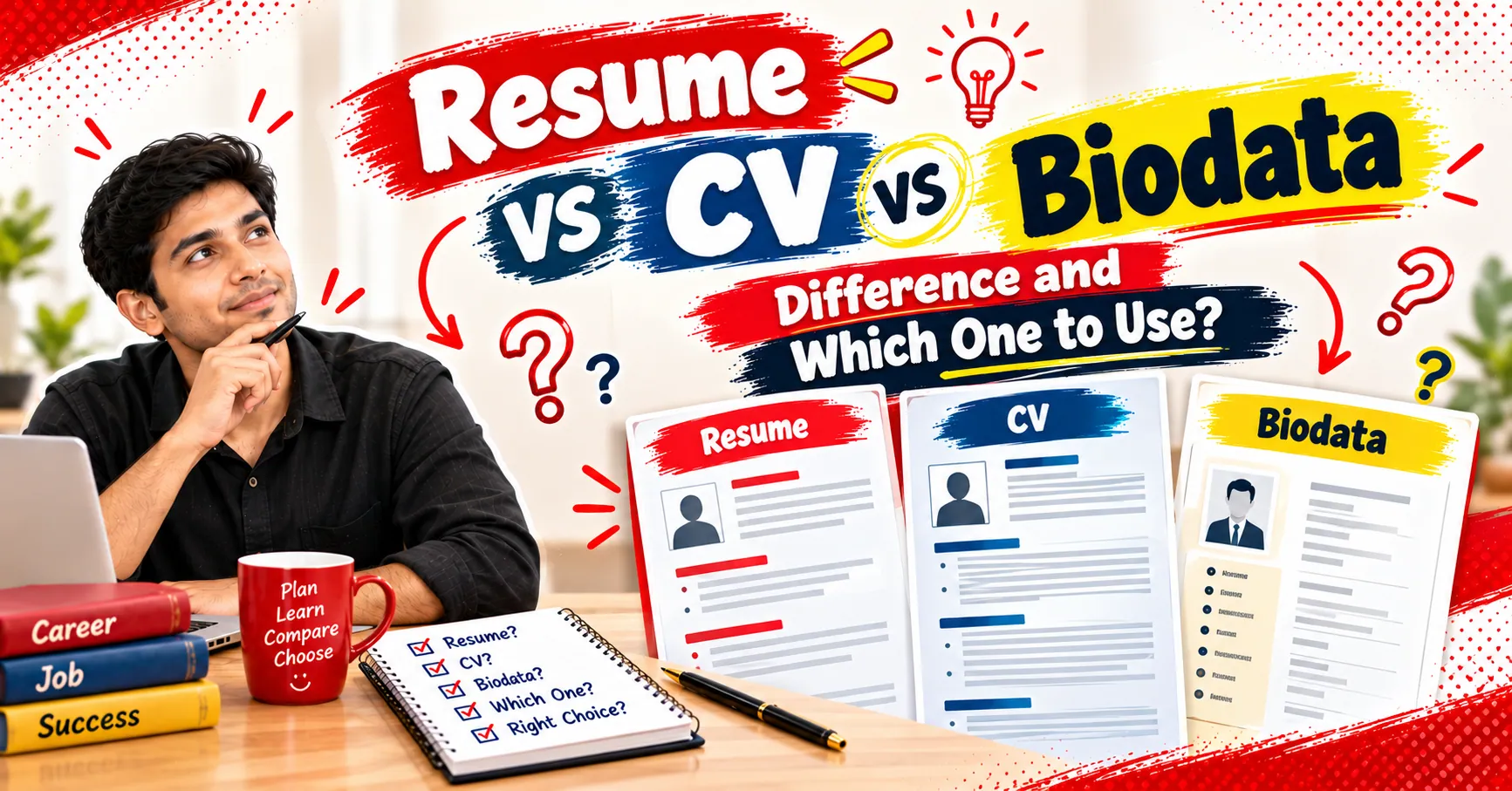
If you only want the quick version, here it is. A resume is a short, targeted summary of your work for a job. A CV is a detailed, complete record of your academic and professional life. A biodata is a personal profile that lists your details like age, family and background, with very little about your skills.
| Point | Resume | CV | Biodata |
|---|---|---|---|
| Full form | Résumé (French for "summary") | Curriculum Vitae (Latin for "course of life") | Biographical Data |
| Main purpose | Get an interview for a specific job | Show your complete academic and career history | Share personal details about you |
| Length | 1 to 2 pages | 2 to 10+ pages | 1 to 2 pages |
| Focus | Skills, experience, achievements | Education, research, publications, everything | Personal and family details |
| Changes per job? | Yes, tailored for each role | Mostly stays the same, new items get added | Rarely changes |
| Photo | Usually not needed | Not needed in most countries | Almost always included |
| Personal details | Minimal (name, phone, email) | Minimal to moderate | Extensive (DOB, religion, family, height) |
| Typically used for | Private sector jobs | Academia, research, medicine, fellowships | Some government forms, marriage profiles, older-style hiring |
What exactly is a resume?
A resume is your sales pitch on paper. It's short on purpose. A recruiter might look at it for less than ten seconds before deciding whether to read on, so the whole point is to show, quickly, that you fit this particular job.
It's also something you're supposed to edit again and again. If you apply for a marketing role on Monday and a content role on Wednesday, the two resumes shouldn't be identical. You move things around, change the summary, pull out the keywords from each job description.
A typical resume has:
- Name and contact details
- A short summary or objective
- Work experience with results
- Skills relevant to the role
- Education
- Certifications or projects, if they help
What exactly is a CV?
A CV is the long version. Think of it as the full story of your academic and professional journey, with nothing trimmed for length. It doesn't get shortened for each job, it just grows as your career grows.
This is the document you'll need if you're applying for a teaching post at a university, a research position, a PhD, a scholarship, a medical role or a fellowship. People in those fields care about your publications, your conferences, your grants and your thesis, which a one-page resume simply can't hold.
A CV usually includes:
- Personal and contact details
- Education in detail, with thesis or dissertation titles
- Work, teaching and research experience
- Publications, papers and presentations
- Grants, awards and honours
- Professional memberships and certifications
- Languages, skills and references where required
What exactly is a biodata?
Biodata is the oldest of the three and, honestly, the one that's slowly fading out of professional hiring. It's focused on you as a person rather than on your work. It reads like a form: your name, father's name, date of birth, nationality, marital status, religion, address, and then a short line on education and experience.
You'll still see it asked for in a few places. Some government departments and public-sector applications want it in a fixed format. Certain small companies, older institutions and a few industries still prefer it. And of course, it's very common for marriage profiles, where the personal and family details are the whole point.
A typical biodata has:
- Full name, father's and mother's name
- Date of birth, age, gender, nationality
- Marital status, religion, caste or category where the form requires it
- Height, weight, blood group (mostly in older-style formats)
- Address and contact details
- Education qualifications
- Brief work experience, hobbies and a declaration at the end
- Passport-size photo and signature
Which one should you actually use?
This depends on what you're applying for, not on which one looks better.
| If you're applying for... | Use this |
|---|---|
| A private company job (IT, marketing, sales, finance, etc.) | Resume |
| A first job as a fresher | Resume (one page) |
| A professor, lecturer or research role | CV |
| A PhD, scholarship or fellowship | CV |
| A medical, scientific or academic position | CV |
| A government job form that asks for it | Biodata, in the format given |
| A marriage profile | Biodata |
| A job abroad (US, Canada) | Resume for most jobs, CV for academic ones |
| A job in the UK, Europe, Australia, New Zealand | CV often means what Indians call a resume, check the posting |
The confusing part: it depends on the country
Here's where people get tripped up. In the US and Canada, "resume" is the short document for regular jobs and "CV" is the long academic one. In the UK, Ireland, Australia, New Zealand and much of Europe, people say "CV" for what Americans call a resume. In India we use both words, sometimes randomly. And in some places, "biodata" is used for either.
So if a job posting says "send your CV," don't panic. Read the rest of the posting. If it's a regular corporate job, a clean one or two-page resume-style document is almost always what they want. If the posting is for a research or academic role, send the full, detailed version.
Mistakes people make with these three
- Sending a biodata, with family and religion details, to a private company that expects a resume
- Sending a ten-page academic CV for a regular corporate job
- Using the same document for every application without checking what the employer asked for
- Adding personal details like marital status or religion to a resume when the job doesn't need them
- Leaving out a photo on a form that specifically asks for one
- Assuming "CV" and "resume" are always the same, without reading the job posting
- Not keeping a master version, so you rewrite everything from scratch each time
A simple way to keep all three ready
If you're someone who applies to different kinds of places, it helps to keep a base document and make versions from it. Start with a master CV that holds everything: every job, project, course and achievement. From it, cut down a tailored one or two page resume for each corporate job. And keep a separate biodata in a neat, standard format for the forms that ask for it. That way you're never scrambling when a form shows up with a short deadline.
| Document | What to keep ready |
|---|---|
| Master CV | Everything, updated every time something new happens in your career |
| Resume | One base version that you adjust for each job |
| Biodata | A clean, standard version with a recent photo and signature |
One last thing
None of these three is "better" than the others. They're just built for different situations, and the trouble starts only when they get mixed up. When in doubt, read the job posting carefully, look at what the employer actually asked for, and match your document to that. If they didn't specify, a well-written one or two page resume is the safest choice for nearly every private sector job.
Did you ever send the wrong document to an employer by mistake? Share it in the comments, you'll probably help someone else avoid the same slip.
Comments
No comments yet. Be the first to comment.