
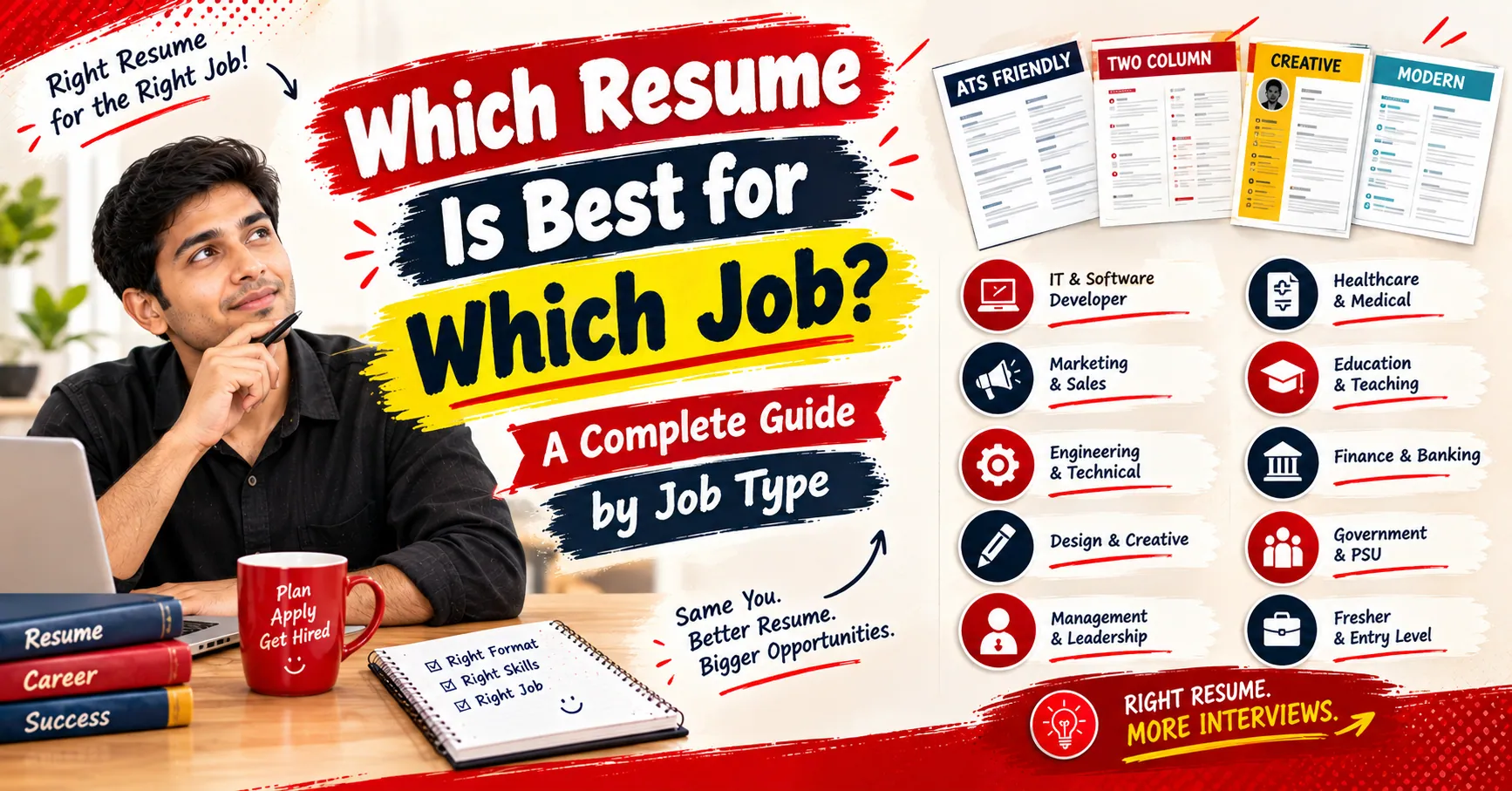
Last year a friend of mine applied to two companies in the same week. Same role more or less, same skills, same years of experience. One called him in two days. The other never wrote back, not even a rejection mail. When he finally showed me what he'd sent, I almost laughed. A bright, two-column, icon-filled resume had gone to a bank, and a plain text one had gone to a design agency. Completely the wrong way round.
I think this is the part people skip. They go hunting for the "perfect resume template" like there's one out there that works for every job. There isn't. A resume that gets a software engineer shortlisted will look odd on a nursing application, and what a creative director loves might get quietly dropped by a government office.
So this post goes job by job. Some of it is common sense, some of it took me years of watching resumes get ignored to figure out. If you don't want to build anything from scratch while you read, you can open ResumeSathi in another tab and make a resume as you go.
The three formats, quickly
Before the job types, you need to know there are really only three ways to lay out a resume. Everything else is decoration on top of these.
| Format | How it works | Good for | Not great if |
|---|---|---|---|
| Reverse chronological | Newest job first, going back in time | Steady career in one field | Big gaps or a total field change |
| Functional | Skills first, work history squeezed to a few lines | Freshers, career changers, people returning after a break | The company uses strict ATS software, some of it can't read this layout |
| Hybrid | Skills summary on top, then history in order | Mid-level people with mixed experience | You barely have anything to list yet |
If you're confused, go with reverse chronological. Recruiters have read ten thousand of them and they know exactly where to look. The other two are for specific situations. On ResumeSathi you can try the same details in different layouts and see which one reads better before you pick.
Things that matter no matter what job you want
A few basics. Use an email address that doesn't embarrass you. Keep one clean font. Write a two or three line summary at the top that says what you actually do, not "hardworking professional looking for a challenging role" (every single resume says this, so it says nothing). Save it as a PDF, and please name the file properly. "Rahul_Sharma_Resume.pdf" is fine. "resume_final_new_v3 (2).pdf" is not.
And proofread. Then read it out loud. Your eyes skip mistakes your mouth won't.
Freshers and fresh graduates
If you've just finished college and have no real job history, your resume is going to feel thin, and honestly that's okay. The people hiring freshers already know you don't have experience. They're looking for signs that you can learn and that you've done something beyond sitting in lectures.
| Section | What to put |
|---|---|
| Length | One page, no exceptions |
| Top | Name, contact, and a short objective written for this particular role |
| Education | Close to the top. Degree, college, year, CGPA if it's decent |
| Projects | Two to four, each with one line on what you built and what you learned |
| Internships | Even a one-month one counts, mention what came out of it |
| Skills | Only things you can talk about in an interview |
| Extras | Certificates, clubs, volunteering, competitions |
The usual fresher mistake is stuffing in every school-level prize and ten skills they've touched once. Pick the best stuff and cut the rest. If this is your first resume ever, a guided builder like ResumeSathi saves you from the awkward guessing about what goes where.
IT and software jobs
Tech recruiters mostly want to know two things: what can you build, and with which tools. Plenty of tech companies also push resumes through ATS filters first, so this is one field where fancy formatting can genuinely cost you an interview. Single column, no graphics, no text boxes.
Group your skills by type (languages, frameworks, databases, cloud) instead of dumping them in one long comma list. Put a GitHub or live project link where it's easy to find. Write bullets like "cut API response time by 35%" and not "worked on APIs". Copy the technology names from the job description exactly, because the software is matching words, not meanings. Oh, and skip those skill bars that show you're 80% good at Python. Nobody knows what that means, including you.
One page is plenty if you have under five years of experience. Two pages after that.
Marketing, digital marketing and content
Marketing resumes can have a bit more personality, but numbers still do the heavy lifting. Traffic growth, leads, followers, conversion rates, ad spend and what it returned. If you ran a campaign and can't remember any numbers, dig through old reports, it's worth the effort.
Mention your tools (Google Analytics, Meta Ads, SEMrush, HubSpot, Canva) and add a link to a portfolio, blog or campaign samples. A slightly modern layout is fine here. Just don't go so far that it stops being readable.
Sales and business development
Sales is probably the most number-obsessed field out there. A sales resume without figures looks weak next to one with them, even if the first person is actually better at the job.
| Weak line | Stronger line |
|---|---|
| Responsible for sales in my region | Hit 118% of annual target across a three-state region |
| Handled client relationships | Kept 92% of key accounts for two years in a row |
| Did cold calling and follow-ups | Brought in 45+ qualified leads a month, about 20% turned into paying clients |
Targets, revenue, rankings. Put them where the eye lands first. One or two pages.
Finance, accounting and banking
This one's conservative, and I mean really conservative. Fancy designs usually work against you. Black text on white, simple headings, reverse chronological order. Done.
List the software you know: Tally, SAP, QuickBooks, Power BI, and Excel with the specific functions you use (pivot tables, VLOOKUP, macros). Put certifications like CA, CFA or CMA up high. Give numbers too, something like "handled accounts payable worth Rs. 4 crore a year" or "brought month-end closing down by two days". And no typos. In a field that runs on accuracy, one typo makes people wonder what else you missed.
Teaching and education
Schools and colleges mostly care about qualifications and subject knowledge, so lead with those: your degree, B.Ed, TET or CTET, NET if you have it. Then the subjects and classes you've taught, and the board (CBSE, ICSE, state). If your students' pass percentage went up, say so. If you've used smart classrooms or online teaching tools, add that too, because a lot of institutes now ask about it in interviews.
Healthcare and nursing
Hospitals want to verify things, so make that easy. Registration or license details, degree, and certifications go first. After that, which areas you've worked in (ICU, OT, paediatrics, emergency) and what kind of hospitals they were. Mention specialised training like BLS or ACLS and any equipment you're trained on. Keep the layout very plain and formal.
Design and creative jobs
Here you can finally bend a few rules, but only if you have the taste to pull it off. A messy creative resume is worse than a boring one, and I've seen plenty of messy ones.
Your portfolio link matters more than the resume itself, so make it impossible to miss. List tools like Figma, Photoshop, Illustrator, After Effects, and name the brands or clients if you can. Also keep a plain, ATS-friendly version in your drawer, because some companies will filter you through software no matter how good your portfolio is.
Government jobs
Government applications run on a completely different logic. Less personal branding, more paperwork. If the notification gives a format, follow it exactly, even if it looks ugly. Give full personal details when asked (date of birth, category, address), and complete education details with board or university, year and marks.
The details here get cross-checked against your documents, so whatever you write has to match your certificates exactly. A small mismatch can cause real trouble.
BPO, customer support and call centre jobs
These are high-volume hirings, so whoever's reading your resume is scanning fast. One clean page is enough. Put your languages up front, add your typing speed if it's good, and mention any customer-facing work, even retail or part-time. Add the tools you've used (CRM software mostly), your shift flexibility, and if you have it, numbers like satisfaction scores or calls handled per day.
Engineering and manufacturing
List the machines, software and standards you actually know. Then show results: downtime reduced, costs saved, output improved, safety record kept clean. Certifications like AutoCAD, SolidWorks or Six Sigma go in their own short section. Plain layout, no tricks.
HR and recruitment
Show hiring numbers: positions filled, time-to-hire, retention. Mention the ATS tools and job portals you've handled and any onboarding or engagement work. A small warning from experience. If you're in HR, people will judge your own resume harder than anyone else's, so the formatting has to be spotless.
Career changers
If you're switching fields, the hybrid or functional format usually helps because it lets skills sit above job titles. Start with a short summary that says plainly what you're moving into and why you're a fit. Then group the skills that carry over, and only after that list your past jobs. Add any course, certification or side project that proves you're serious.
And don't apologise for the switch anywhere in the resume. Just state it confidently. Rearranging the same experience for a new field is exactly where a builder like ResumeSathi helps, since you can reorder sections without breaking the whole layout.
Senior and leadership roles
Two pages is completely fine here. Open with a short executive summary that shows scale: team size, budget, business impact. Then talk about outcomes and decisions, not daily tasks. Older roles can shrink to a line or two. Nobody needs to know what you did in your first job eighteen years ago.
All of it in one table
| Job type | Best format | Design | Length | Highlight |
|---|---|---|---|---|
| Fresher | Hybrid or functional | Simple, clean | 1 page | Projects, education, skills |
| IT / software | Reverse chronological | Plain, ATS-friendly | 1 to 2 pages | Tech stack, projects, impact |
| Marketing | Reverse chronological | Modern but readable | 1 to 2 pages | Metrics, tools, portfolio |
| Sales | Reverse chronological | Clean, results first | 1 to 2 pages | Targets, revenue |
| Finance / banking | Reverse chronological | Minimal, conservative | 1 to 2 pages | Certifications, software, accuracy |
| Teaching | Reverse chronological | Structured, professional | 1 to 2 pages | Qualifications, subjects, results |
| Healthcare | Reverse chronological | Clean, formal | 1 to 2 pages | License, clinical experience |
| Design / creative | Hybrid | Creative but tasteful | 1 to 2 pages | Portfolio, tools |
| Government | As per notification | Plain, document style | As required | Complete, matching details |
| BPO / support | Simple chronological | Easy to scan | 1 page | Languages, communication, CRM |
| Career changer | Functional or hybrid | Skill-focused | 1 to 2 pages | Transferable skills |
| Senior / leadership | Reverse chronological | Polished, minimal | 2 pages | Strategic impact, scale |
Mistakes I keep seeing
- Sending one identical resume to every job
- An email like coolboy_2003@something
- Photo, religion, marital status when the job didn't ask for any of it
- Listing duties instead of what actually changed because of you
- Making it too crowded, or too fancy for the industry
- Ignoring the keywords sitting right there in the job description
- Exaggerating. It nearly always comes out at the interview or the background check.
A simple way to put it together
- Read the job description and note the skills it keeps repeating.
- Choose the format that fits your experience and the industry.
- Write the short summary last, it's easier once everything else is down.
- Fill in your experience with results, not tasks.
- Keep only the skills, projects and certificates that matter for this job.
- Check fonts and spacing, then proofread, then save as PDF.
If you'd rather skip the formatting fights and just get to the writing, ResumeSathi lets you build and download a clean resume in a few minutes. Tweak it a little for every application after that.
One last thing
Good resumes aren't about clever words or fancy design. They just show the right person, in the right way, that you can do this particular job. The same experience can look average or impressive depending on how it's presented, which is why spending ten extra minutes per application usually pays off.
When you're ready, go to ResumeSathi and make one that actually fits the job you're after.
Which kind of job are you applying for right now? Tell me in the comments, I'll tell you what I'd focus on in your resume.

Comments
No comments yet. Be the first to comment.