
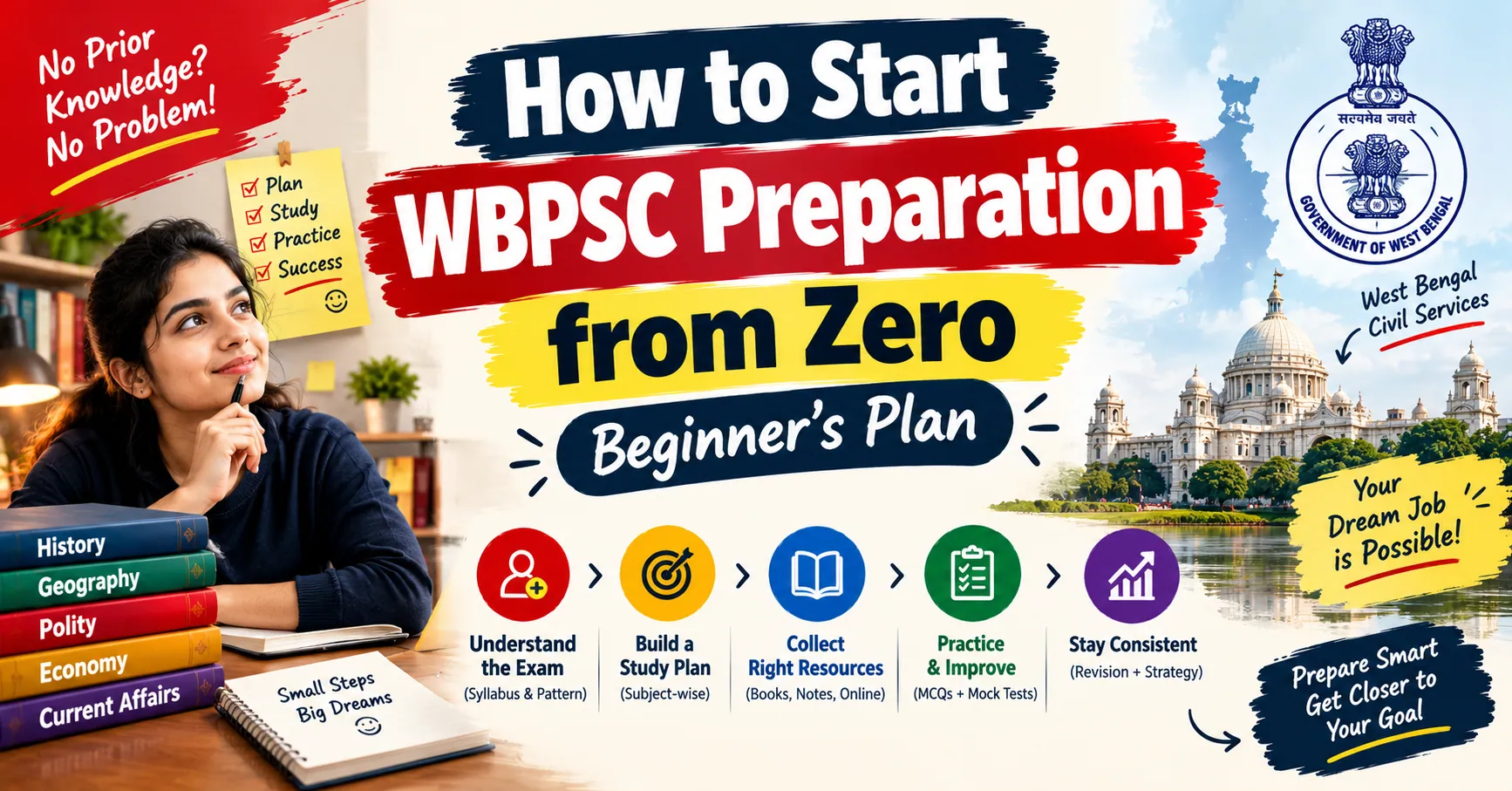
If you are starting from nothing, the West Bengal Public Service Commission exams can look like a wall. Too many subjects, too many books, and everyone online says something different. The good news is that the first few weeks don't need a lot of money or a big plan. They need a clear idea of what the exam is and a simple routine you can actually follow.
WBPSC conducts several recruitment exams, but when most people say they are preparing for WBPSC, they mean the West Bengal Civil Service (WBCS) exam. That is the flagship exam, so this guide is built around it. The base you build here also helps with other WBPSC exams that test general studies.
The Commission updates the syllabus and exam pattern from time to time, and some reports mention a revised mains structure. Use this article to understand the overall approach, and confirm the latest pattern and syllabus on the official WBPSC website before you finalise your plan.
First, understand what you are preparing for
WBCS has three stages, and each one tests something different. Knowing this changes how you study from day one.
| Stage | What it is | Key points |
|---|---|---|
| Prelims | One objective paper | 200 questions, 200 marks, around 2.5 hours, negative marking of one-fourth. Marks decide who goes to mains and are usually not added to the final score |
| Mains | Written papers, a mix of descriptive and objective | Group A and B candidates have six compulsory papers plus an optional subject (two papers), usually 1600 marks. Groups C and D have a smaller total |
| Interview | Personality test | Carries marks that depend on the service group. Final merit is mainly mains plus interview |
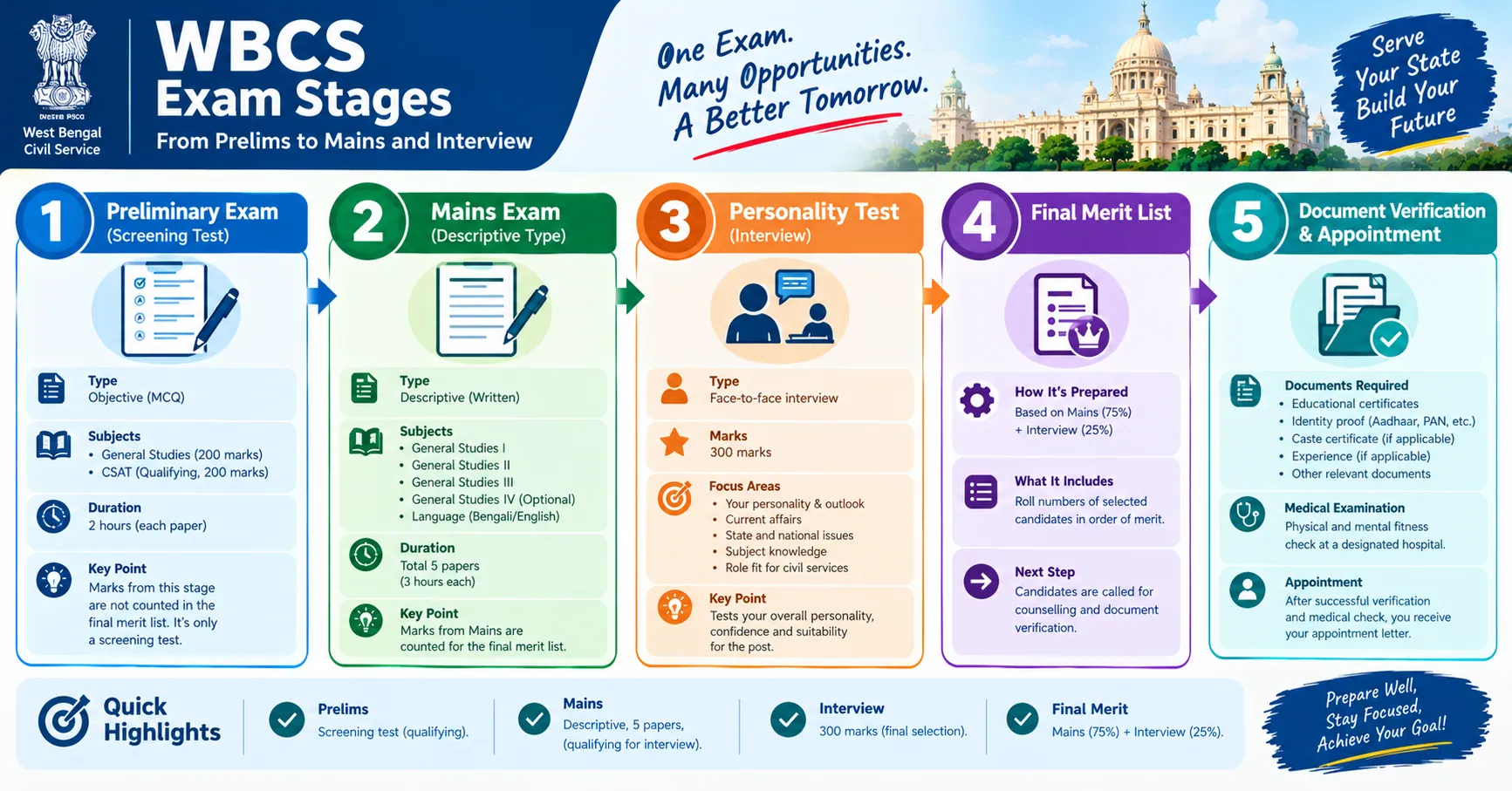
The point to take from this is simple. Prelims is a filter, mains is where the real score is made, and the interview comes last. So even if you spend the first few months on prelims topics, you should keep mains in mind. Reading with understanding, not just memorising facts, will matter later.
Check your eligibility before you invest months
This takes ten minutes and saves a lot of pain later. Some basic conditions you will normally find in the notification:
- You must be an Indian citizen
- You need a bachelor's degree in any stream from a recognised university
- The usual age range for general candidates is around 21 to 36 years, with relaxation for reserved categories and other groups as per state rules
- Some services need a working knowledge of Bengali or another listed language, so read the language condition carefully
Rules change a little between notifications, so treat this list as a guide. If you are in your final year of graduation, check whether you can apply before the degree result comes out. Usually you need the degree by the last date of application.
Day one: get the syllabus and old papers
Before you buy a single book, download the official syllabus and a few previous year question papers. Spend a couple of hours reading the papers, not solving them. You will see the kind of questions asked, which topics repeat, how heavily Bengal-related content shows up, and how current affairs are used.
This one habit stops you from wasting weeks on topics that hardly appear, and from ignoring ones that appear every year.
A beginner's plan, phase by phase
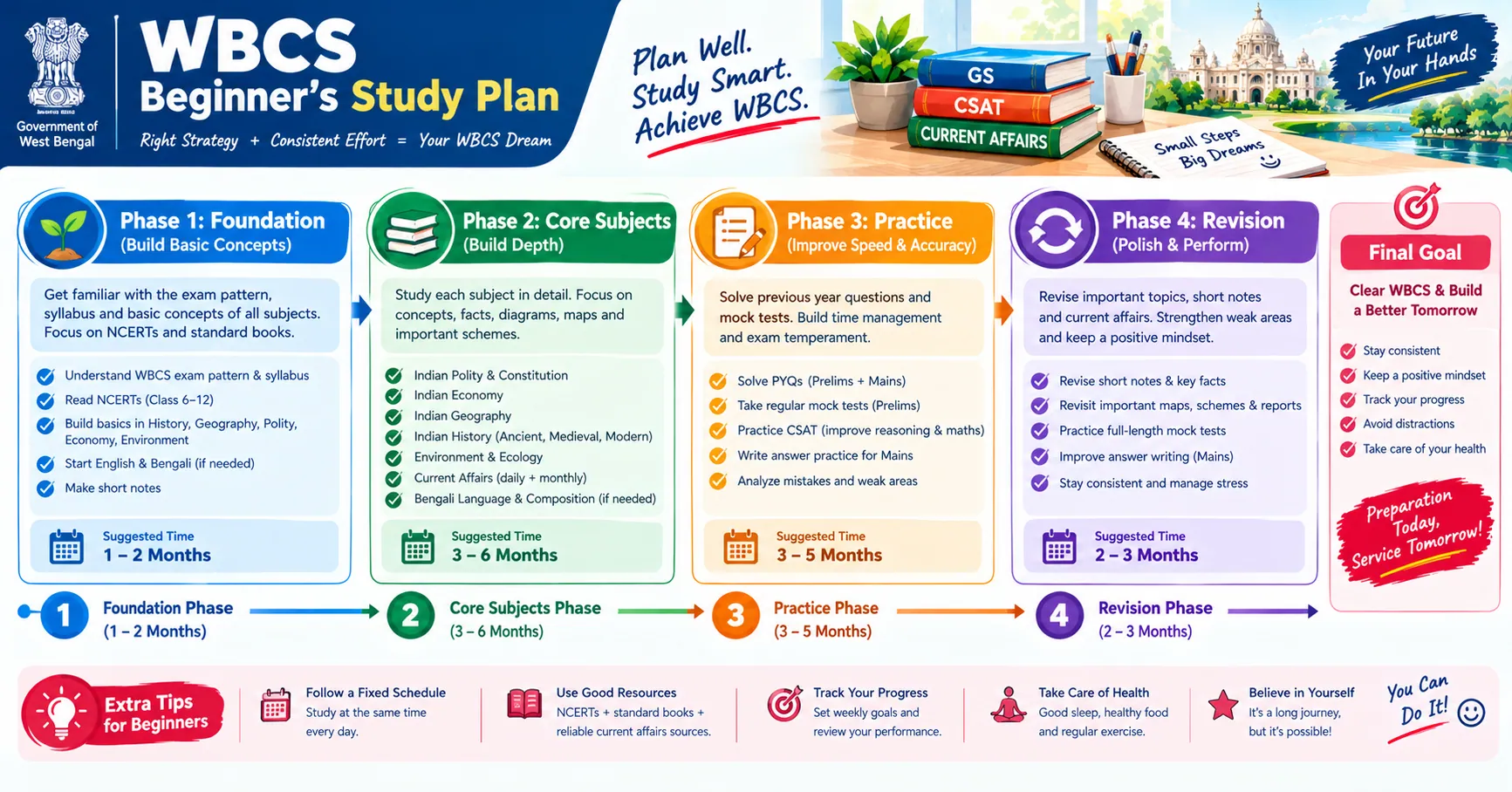
Everyone's pace is different. A working person may need more time than a full-time student. But as a rough guide, many beginners need around ten to twelve months of steady work before the exam feels manageable. Here is a plan you can adjust.
| Phase | Rough time | What to do |
|---|---|---|
| Foundation | First 2 months | Read NCERT basics for history, geography, polity and economy. Start a newspaper habit. Brush up school-level maths. No heavy books yet |
| Core subjects | Months 3 to 6 | Go deeper into each subject using the syllabus as a checklist. Add Bengal-specific topics. Make short notes as you go |
| Practice | Months 7 to 9 | Start topic-wise tests and previous papers. Begin writing answers for the descriptive papers. Fix weak areas |
| Revision and mocks | Last 2 to 3 months | Full-length mocks, repeated revision of your short notes, and daily current affairs revision |
Where to start in each subject
You don't have to finish one subject completely before touching the next. Rotate through them so nothing goes cold. Here is where to begin in each area.
| Subject | Where to begin | Don't forget the Bengal angle |
|---|---|---|
| History | NCERT for ancient, medieval and modern India, then a standard modern history book | Bengal Renaissance, partition of Bengal, freedom movement in Bengal, social reformers |
| Geography | NCERT for basics of physical, Indian and world geography | Rivers, soils, climate, agriculture and districts of West Bengal |
| Polity | NCERT basics, then a standard polity book for the Constitution and governance | State legislature, local government and panchayati raj in West Bengal |
| Economy | NCERT economics, then basics of Indian economy and budget terms | State economy, major schemes and budget highlights of West Bengal |
| General science | School science up to Class 10, with everyday science and health topics | Environment and local issues linked to the state |
| Maths and reasoning | Basic arithmetic, percentages, ratios, series and logical reasoning | Practise with timer from the start, since speed matters |
| English | Grammar basics, vocabulary and daily reading | Start writing short paragraphs early for the mains |
| Current affairs | One good newspaper every day, plus a monthly compilation | Follow West Bengal news closely, such as policies, schemes and major events |
Make newspaper reading a daily habit
Current affairs are used in prelims and mains, and they are also useful in the interview. Reading a newspaper cover to cover is not necessary. Spend about 45 minutes on the main news, economy, editorial and state pages, and write down only what could be a question: a scheme, an appointment, a report, a decision, a place in the news. At the end of each week, read your notes again, and at the end of each month, turn them into one page.
Start answer writing earlier than you think
Many beginners wait until prelims is over before they pick up a pen, and then find their handwriting slow and their answers vague. The descriptive papers, including English and the language paper, test writing skill that takes months to build.
You don't need long essays in the first month. Try one short paragraph a day on a topic you read, in simple language. Later, move to timed answers. Keep your sentences plain and direct, because examiners read hundreds of copies and a clear answer beats a fancy one.
A daily routine that is realistic
Instead of copying a topper's schedule, build one around your actual day. If you study full-time, four to six focused hours is a good place to start. If you are working, even two hours on weekdays and four to five on weekends can add up, as long as you are consistent.
- One block for a main subject, when your mind is freshest
- One block for maths or reasoning practice
- Thirty to forty-five minutes for the newspaper
- A short revision slot in the evening for that day's notes
- One day a week for a test and review of mistakes
The routine matters less than showing up every day. A plan you follow for six months beats a perfect plan you drop in three weeks.
Tests and revision
Start with small topic tests once you finish a chapter, then move to full-length mocks in the last few months. The score is not the point at first. What you want is a record of your mistakes. Keep a notebook, write down every wrong answer and why you got it wrong, and read it before the next test. Most people lose marks by repeating the same kind of error.
Revision should be built in from the start. A simple rule works well: look at each topic again after one day, one week and one month. Short notes make this possible. If your notes are longer than the original book, they are not notes.
Mistakes beginners usually make
- Buying too many books and finishing none of them
- Jumping between sources instead of sticking to one or two per subject
- Skipping Bengal-specific topics because they feel small
- Ignoring maths and reasoning until the last month
- Never writing answers until mains is near
- Reading the newspaper without making any notes
- Comparing yourself to people who have been preparing for years
- Skipping revision because new topics feel more productive
Resources that don't cost much
You can start strong with very little money. The official WBPSC website for notifications, syllabus and previous papers. NCERT books for the basics. A daily newspaper in English or Bengali. For the Bengal side of economy, the state budget speech and the West Bengal economic review are both free online and worth reading. Free mock tests and previous paper discussions online. Add coaching or paid test series later only if you feel you need structure or feedback.
Common questions
Can I prepare while working a full-time job?
Yes, many people do. It will take longer, so plan for a longer timeline, protect a fixed daily slot, and use weekends for the heavy work. The first two months are the hardest to build the habit, and after that it gets easier.
Do I need coaching?
Not at the start. Coaching can help with structure and doubt-solving, but it cannot study for you. Many candidates begin on their own with the syllabus, NCERT and previous papers, and decide on coaching after a few months.
Do I need to know Bengali?
It depends on the service and the notification. Several parts of the exam and the later stages favour candidates comfortable with Bengali or one of the other listed languages. Read the language rule in the latest notification, and if you are weak in the language, start practising early.
How many hours should I study every day?
There is no magic number. Four to six focused hours daily is a common starting point for full-time aspirants, and two to three for working candidates. Two hours of proper study is worth more than six hours with your phone next to you.
Is WBCS the only WBPSC exam?
No. The Commission conducts other recruitment exams as well, with different syllabuses. The general studies base you build for WBCS is still useful for many of them, but always check the syllabus of the exam you are targeting.
Final word
Starting from zero is not a disadvantage. Everyone who clears the exam began somewhere, usually with a confusing first month and a few wasted books. What helps most is knowing the exam pattern, reading the syllabus properly, building a daily routine you can keep, and testing yourself often. Start this week, even with just one hour, and adjust as you learn what works for you.
Starting your WBPSC preparation? Tell us which subject feels hardest right now in the comments.





Comments
No comments yet. Be the first to comment.