
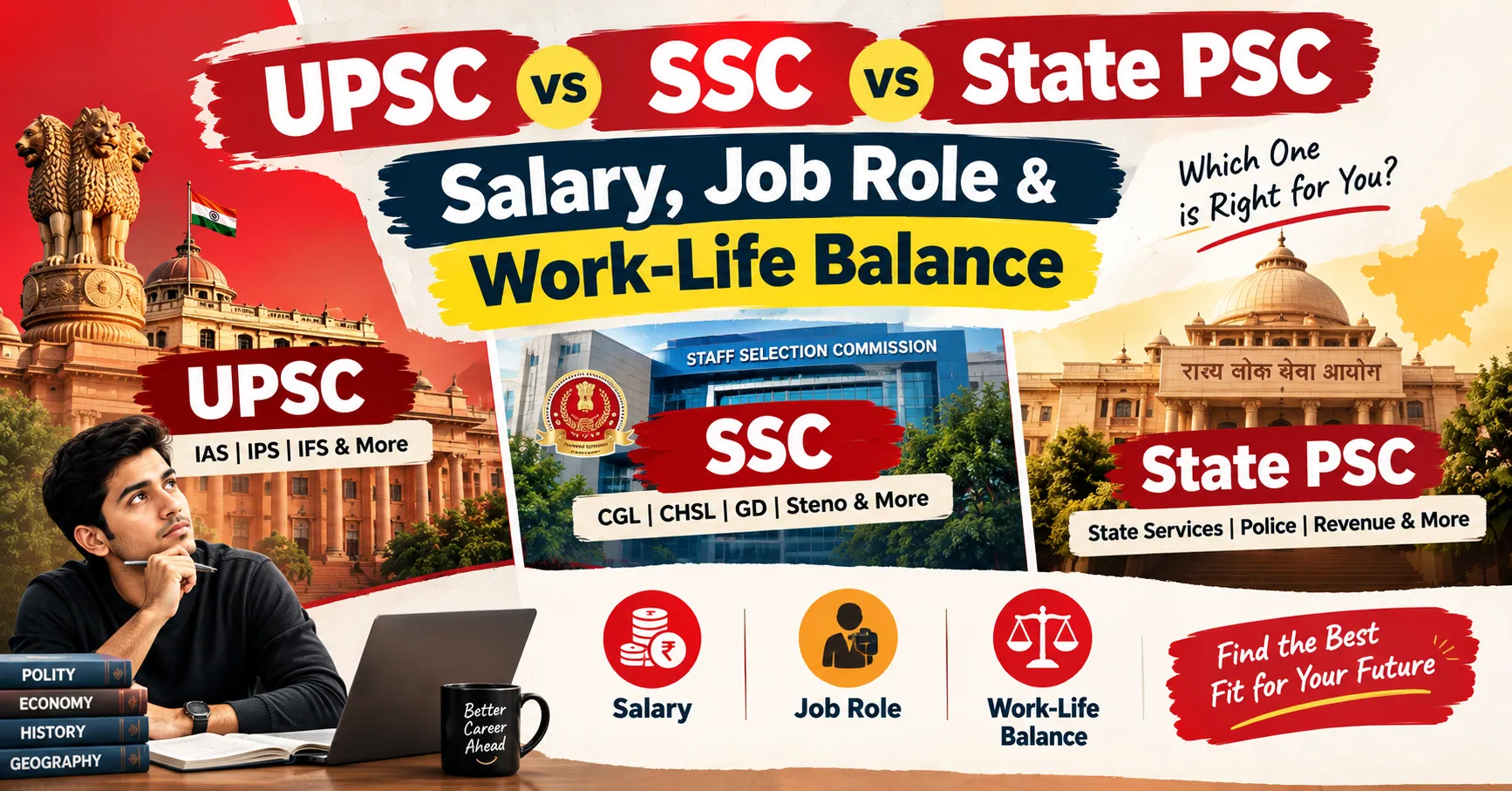
If you are preparing for a government job in India, sooner or later you hit the same question. Should I go for UPSC, SSC, or my state PSC?
Most articles on this topic give you a neat table and call it a day. The real difference shows up after you join. It shows up in where you live, how often your bags are packed, who calls you at 11 pm, and how much of your life is still yours.
This guide covers all of that, in plain words.
The quick picture
| Point | UPSC (Civil Services) | SSC (CGL) | State PSC |
|---|---|---|---|
| Typical entry post | IAS, IPS, IFS and other Group A services | Inspector, Assistant Section Officer, Auditor, Tax Assistant | Deputy Collector, DSP, BDO, Tehsildar and similar |
| Pay level at entry | Level 10 (basic ₹56,100) | Level 4 to Level 8 for most posts | Depends on the state, often close to central levels |
| Competition | Extreme | Very high | High, but varies by state |
| Posting | All India, or your allotted state cadre | Mostly central offices, many in metros | Your own state only |
| Transfers | Frequent | Moderate | Frequent, mostly inside the state |
| Work pressure | Highest | Moderate | High in field posts |
Now let's go through each one properly.
Salary: what actually reaches your bank account
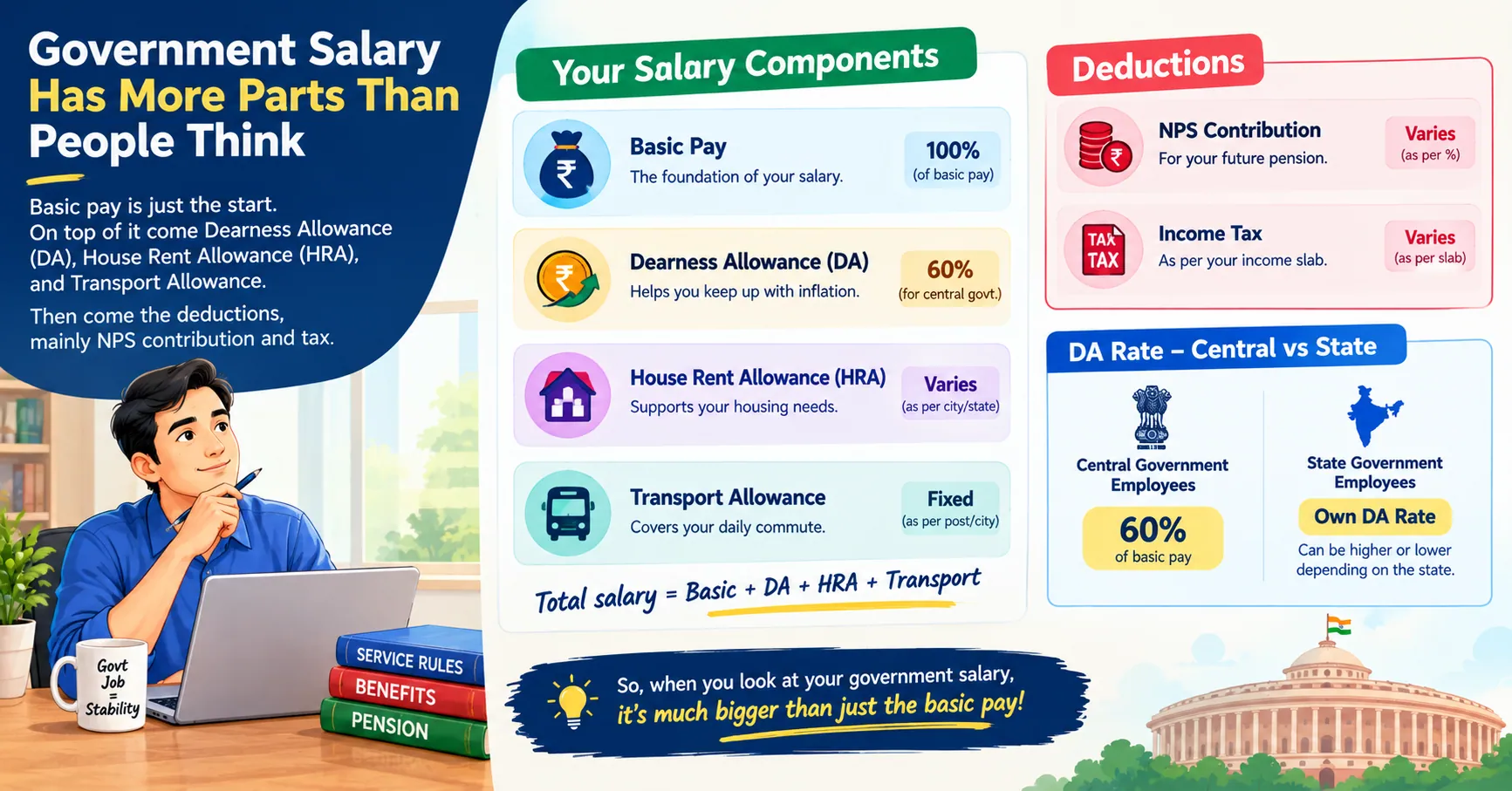
Government salary has more parts than people think. Basic pay is just the start. On top of it come Dearness Allowance (DA), House Rent Allowance (HRA), and Transport Allowance. Then come the deductions, mainly NPS contribution and tax.
DA is currently 60% of basic pay for central government employees. State employees get their own DA rate, which can be higher or lower depending on the state.
UPSC (IAS, IPS and others)
A fresh officer starts at Level 10 with a basic of ₹56,100. With 60% DA added, that is roughly ₹90,000 before other allowances. The twist is that the salary is not the main thing here. Government housing, an official vehicle, staff, security in some posts, and the sheer authority of the post make the package much bigger than the number on the payslip. Salary also grows steadily, and senior officers reach the secretary level with a fixed pay far above what a fresh officer earns.
SSC CGL posting
Where you end up depends on the department. Income Tax, Customs and Excise have offices in almost every state, so you could land in Nagpur or Guwahati as easily as Delhi. Most ministry jobs, like Assistant Section Officer, sit in Delhi. You can ask for a transfer to your home region after a few years, but nobody promises it. Some people get it in five years, some wait ten.
State PSC posting
You stay in your own state, and honestly that's the biggest reason people choose this route. Your language, your food, parents a short train ride away. The catch is the first posting. New officers usually get the district nobody wants, and later transfers inside the state can come suddenly.
Work-life balance
UPSC gives you the most respect and the least free time. A DM or SP can get a call at 2 am about a riot, a bridge collapse or a minister's visit, and you go. Diwali, Eid, your sister's wedding, none of it is safe from the phone. A lot of officers say the job slowly becomes who they are. If you want evenings with your family, think twice. If you want to actually change things in a district, there's no better seat.
SSC jobs are the easy ones to live with. Most offices run on fixed hours, Saturdays and Sundays are mostly yours, and getting leave isn't a fight. The price you pay is growth. Promotions are slow, and plenty of people sit in the same grade for ten or fifteen years waiting for the next one.
State PSC lands somewhere between the two. A Tehsildar or DSP on field duty gets calls at odd hours, same as an IAS officer, just at a smaller scale. A desk job in the state secretariat is much calmer. One more thing nobody mentions in coaching ads: in some states, local politicians have a lot of say in your posting, and that can make life hard if you don't play along.
Competition and preparation time
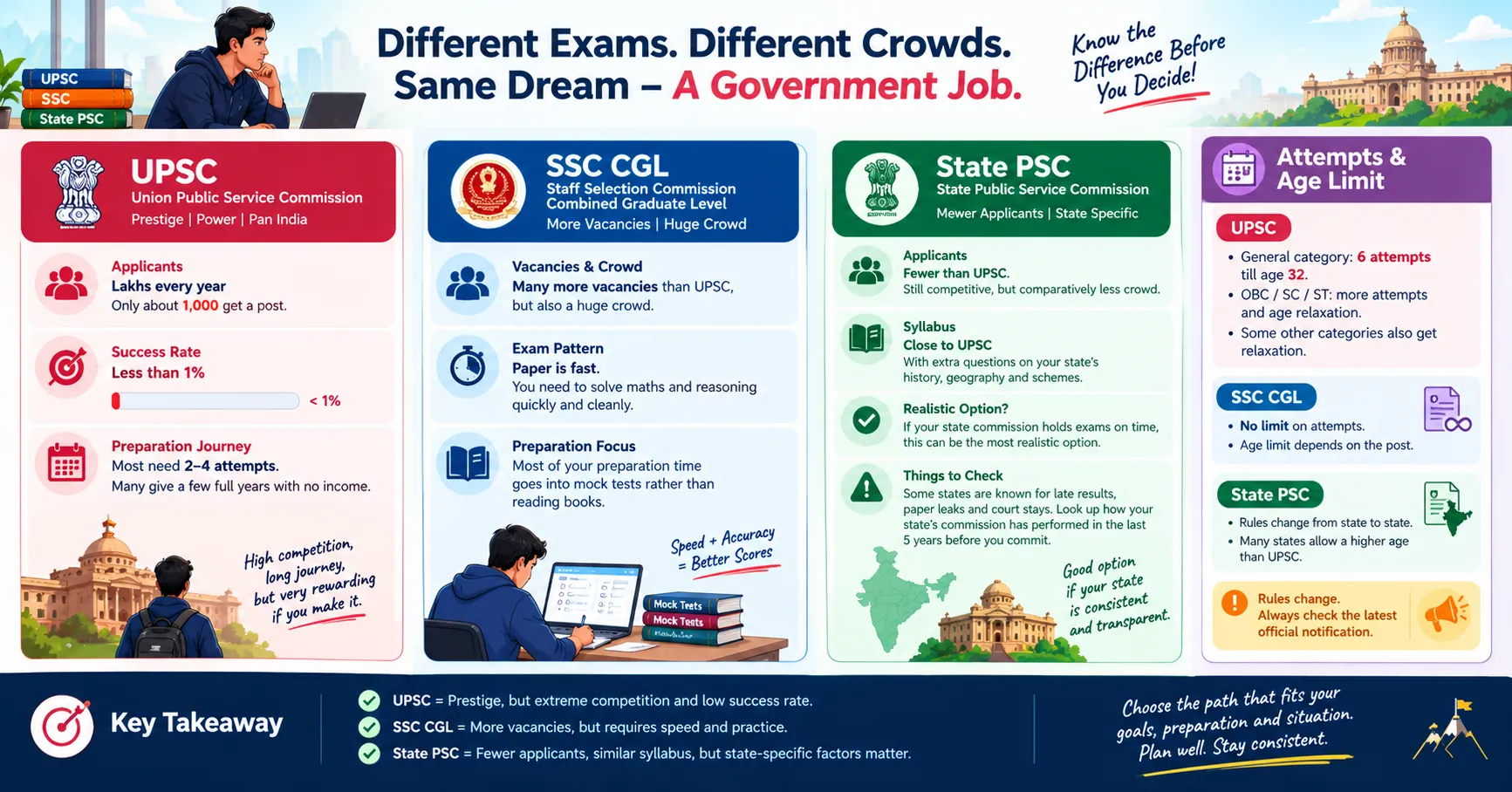
Lakhs of people fill the UPSC form every year and only about a thousand get a post. Less than one percent make it. Most of the people who clear it needed two to four attempts, and many gave a few full years to it with no income.
SSC CGL has many more vacancies, but also a huge crowd. The paper is fast. You need to solve maths and reasoning quickly and cleanly, so most of your preparation time goes into mock tests rather than reading books.
State PSC has fewer applicants than UPSC. The syllabus is close to UPSC, with extra questions on your state's history, geography and schemes. If your state commission holds exams on time, this can be the most realistic option. But some states are famous for late results, paper leaks and court stays, so look up how your own state's commission has behaved in the last five years before you commit.
Attempts and age limit: UPSC gives general category candidates six attempts till age 32, with more attempts and age relaxation for OBC, SC, ST and some other categories. SSC CGL has no limit on attempts, but the age limit depends on the post. State PSC rules change from state to state, and many allow a higher age than UPSC. Rules change, so check the latest official notification.
Which one should you pick?
There's no single right answer. Here's how I'd think about it.
If you want power and can handle years of preparation and a life on the move, go for UPSC. If you want a steady central job with regular hours and you're fine not being the final decision-maker, SSC fits better, and it also helps if you need to start earning sooner. If staying near home matters most, and you still want a post with real responsibility, State PSC makes sense.
You don't have to pick only one. Many UPSC aspirants also write SSC and their state exam as a backup, and that works well until it starts eating into your main preparation. Then it doesn't.
Before you decide
Don't choose by salary or the name of the post alone. Picture your life ten years from now and ask which of these jobs you can actually live with.
Better still, find someone who is already in the service and ask about their worst week on the job, not their best. That one talk will tell you more than any article, this one included.
Note: Salary, DA and exam rules in this article follow the 7th Pay Commission structure and the rules at the time of writing. The 8th Pay Commission or new notifications can change them, so check official sources before you decide.





Comments
No comments yet. Be the first to comment.