

RRB NTPC (Non-Technical Popular Categories) is one of the most popular railway recruitments in India. It is run in two levels: one for graduates and one for 12th pass candidates. They look alike, but the age limit, posts, pay and day-to-day work are quite different. This guide puts both levels side by side, so you can see which one suits you before you read a single notification.
Railway Recruitment Boards can change posts, age limits, pay levels and the exam pattern between cycles. This article explains how the two levels normally work. For the final word on any cycle, read the official Centralised Employment Notification (CEN).
The quick comparison
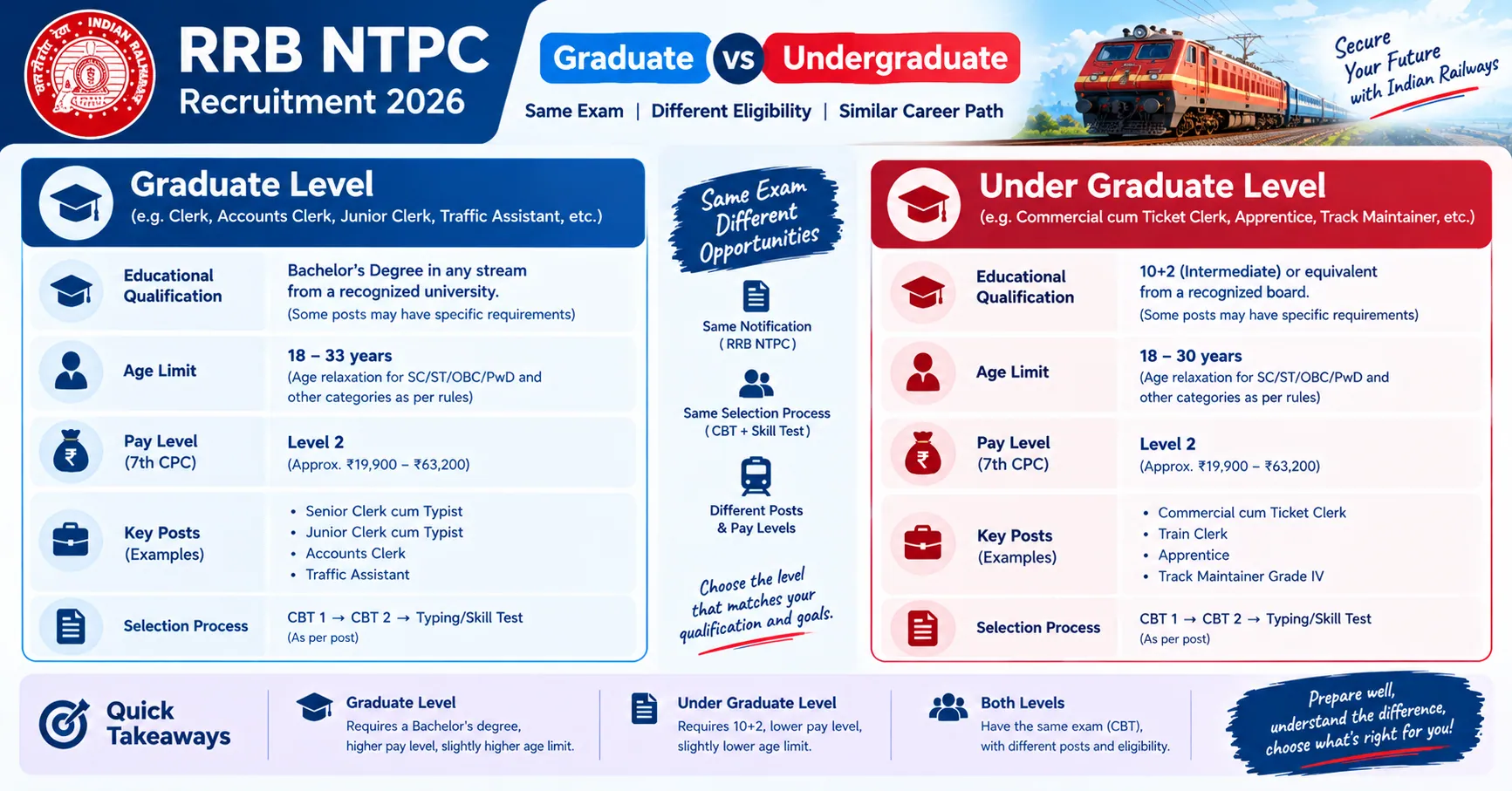
| Point | Graduate level | Undergraduate level |
|---|---|---|
| Qualification | Bachelor's degree from a recognised university | Class 12 pass or equivalent |
| Usual age limit | 18 to 33 years | 18 to 30 years |
| Pay levels | Level 4, 5 and 6, depending on the post | Level 2 and 3, depending on the post |
| Typical posts | Goods Train Manager, Station Master, Chief Commercial-cum-Ticket Supervisor, Senior Clerk-cum-Typist, Junior Accounts Assistant-cum-Typist | Commercial-cum-Ticket Clerk, Accounts Clerk-cum-Typist, Junior Clerk-cum-Typist, Trains Clerk |
| Selection stages | CBT 1, CBT 2, skill test for some posts, document verification, medical | CBT 1, CBT 2, typing test for typist posts, document verification, medical |
| Exam style | Computer-based, objective questions | Computer-based, objective questions |
The age limit is counted as on a cut-off date given in each notification, not on the day you apply. Always check that date for your cycle.
Eligibility in detail
Education
Graduate posts need a degree in any stream from a recognised university. Undergraduate posts need Class 12 or an equivalent qualification. Because the undergraduate requirement is a minimum, a graduate can usually apply for undergraduate posts too, though the lower age limit of 30 still applies. Check the wording in the CEN before you decide.
Eligibility is normally judged on the qualification you hold by the last date of application. A final-year student who has not completed the degree by then generally cannot apply for graduate posts.
Age and relaxation
The upper age limit is usually 33 for graduate posts and 30 for undergraduate posts. Relaxation is given as per railway rules, which commonly means 3 years for OBC-NCL and 5 years for SC and ST candidates, with extra relaxation for persons with disabilities and ex-servicemen.
Nationality, fee and medical standards
You must be an Indian citizen, with the usual exceptions for people from Nepal and Bhutan and certain Tibetan refugees. In recent notifications, the application fee has been ₹500 for General candidates and ₹250 for SC, ST, PwBD, women, transgender candidates, ex-servicemen, minority communities and economically backward candidates.
Medical standards are different for each post. Jobs involving train safety, like Goods Train Manager and Station Master, have stricter vision and fitness rules than clerical posts. The medical category for every post is listed in the CEN.
Posts you can get
Graduate level
| Post | Pay level | What the job is |
|---|---|---|
| Station Master | Level 6 (₹35,400) | Controls train movement at a station and is responsible for safe operation |
| Chief Commercial-cum-Ticket Supervisor | Level 6 (₹35,400) | Supervises ticketing and commercial work at stations |
| Goods Train Manager | Level 5 (₹29,200) | In charge of a goods train on the run, including safety, paperwork and coordination with control |
| Junior Accounts Assistant-cum-Typist | Level 5 (₹29,200) | Accounts and office work, with typing |
| Senior Clerk-cum-Typist | Level 5 (₹29,200) | Office clerical work, files and typing |
| Traffic Assistant, Senior Commercial-cum-Ticket Clerk and similar | Level 4 and 5 | Station and traffic work, appearing in some cycles |
Not every post appears in every cycle. Some notifications cover only a few of these, so check which posts are listed before you plan around one.
Undergraduate level
| Post | Pay level | What the job is |
|---|---|---|
| Commercial-cum-Ticket Clerk | Level 3 (₹21,700) | Booking counters, reservations and passenger queries at stations |
| Accounts Clerk-cum-Typist | Level 2 (₹19,900) | Accounts work and typing in railway offices |
| Junior Clerk-cum-Typist | Level 2 (₹19,900) | General office work and typing |
| Trains Clerk | Level 2 (₹19,900) | Records and coordination of train movement |
Salary: what the pay levels mean
The basic pay for each level comes from the pay matrix of the Pay Commission in force. Railway employees get several things on top of it: Dearness Allowance (DA), House Rent Allowance (HRA) and Transport Allowance. Deductions like NPS contribution and income tax come off after that. DA is revised from time to time, and HRA depends on the class of the city you are posted in.
| Pay level | Starting basic pay (7th CPC) | Posts that usually fall here |
|---|---|---|
| Level 2 | ₹19,900 | Junior Clerk, Accounts Clerk, Trains Clerk |
| Level 3 | ₹21,700 | Commercial-cum-Ticket Clerk |
| Level 4 | ₹25,500 | Some traffic and commercial posts |
| Level 5 | ₹29,200 | Goods Train Manager, Senior Clerk, Junior Accounts Assistant |
| Level 6 | ₹35,400 | Station Master, Chief Commercial-cum-Ticket Supervisor |
To estimate your monthly gross, add DA at the current rate and HRA for your posting city to the basic pay. Your actual in-hand amount will be lower after NPS and other deductions. A posting in a metro pays more in HRA than a small town does.
The jump from Level 2 to Level 6 is large. That gap is the main reason people with a degree aim for the graduate posts. Pay levels can also be revised whenever a new Pay Commission is implemented, so treat the figures above as the current structure and not a permanent one.
Exam pattern
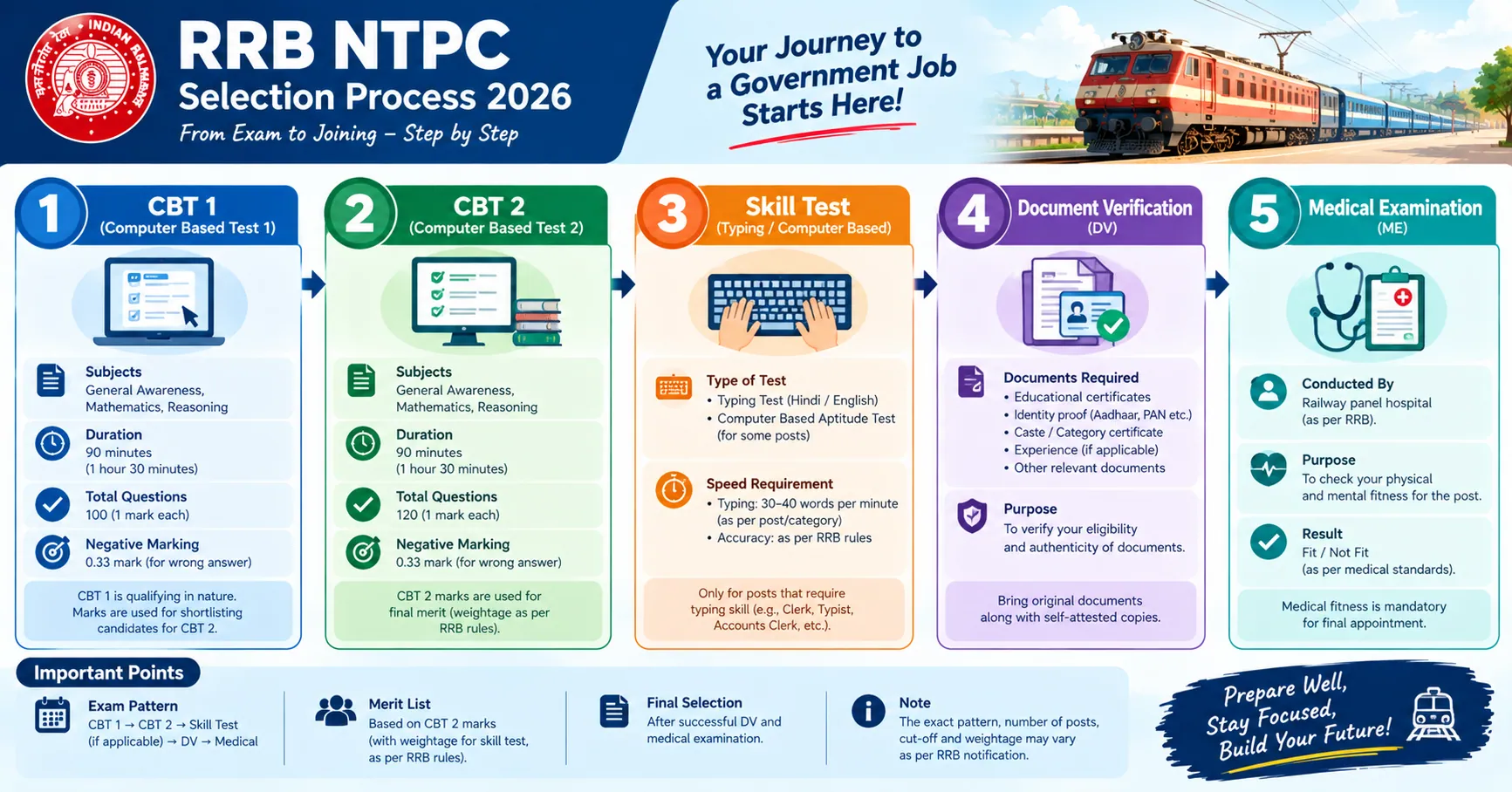
The selection process is built on the same stages for both levels. The exact stages depend on the post.
- CBT 1, a screening test
- CBT 2, the main test
- Typing skill test for typist posts, or an aptitude test for posts like Station Master and Traffic Assistant
- Document verification
- Medical examination
CBT 1
| Section | Questions |
|---|---|
| General Awareness | 40 |
| Mathematics | 30 |
| General Intelligence and Reasoning | 30 |
| Total | 100 questions, 90 minutes |
There is a negative mark of one-third for each wrong answer. CBT 1 is used to shortlist candidates for the next stage, and its marks are generally not counted in the final merit.
CBT 2
| Section | Questions |
|---|---|
| General Awareness | 50 |
| Mathematics | 35 |
| General Intelligence and Reasoning | 35 |
| Total | 120 questions, 90 minutes |
CBT 2 marks decide the merit list for most posts. Typist posts add a qualifying typing test, and posts like Station Master and Traffic Assistant add an aptitude test. After that, shortlisted candidates go through document verification and a medical. Marks in these later stages are mostly qualifying in nature, but the rules differ by post, so read them in the CEN.
The numbers above follow the standard NTPC format used in recent cycles. Check the pattern in the CEN of the cycle you are applying for, in case the board changes it.
What the job is like
The two levels feel different once you join. Graduate posts like Goods Train Manager involve duty on the run, long hours away from home and responsibility for the train and its crew. Station Masters run shifts that cover nights and holidays, because stations never close. The pay is better, but the schedule is harder.
Clerk posts, on both the graduate and undergraduate side, are mostly office jobs with more regular hours. Ticket clerks work station shifts, which can include nights and weekends. Postings are within the railway zone you are allotted, and transfers are common, especially early on. If staying in a particular city matters to you, look at the region and zone you apply under before you fill the form.
Growth after joining
Railway jobs move through promotions and departmental exams. Many people join at a lower level and move up over the years, for example from clerk posts to senior clerk or supervisor posts through seniority and exams. The speed depends on vacancies in your department, and it is generally slower than people expect, so treat the starting post as the one you will hold for a good few years.
Which level is right for you?
If you have a degree and are within the age limit, the graduate level is usually the better choice. The pay is higher, the posts are more senior, and there is more room to grow. The trade-off is that jobs like Goods Train Manager and Station Master involve irregular duty.
If you are 12th pass without a degree, the undergraduate level is your way in. It is a stable entry into the railways, and you can aim for higher posts later through departmental routes and, in the meantime, complete a degree to open the graduate level in future cycles.
If you are in the last year of your degree, remember that you may not be eligible for graduate posts until the degree is complete. Plan your attempts around that.
Some cycles have allowed candidates to apply to both levels. Read the rule in the CEN, because when it is allowed, applying to both can be a sensible backup.
Preparation: one plan works for both
The syllabus for the two levels is almost the same: General Awareness, Mathematics and Reasoning, at similar difficulty. So you do not need two separate plans.
- Maths and reasoning together carry the most marks, so give them steady daily practice
- For General Awareness, cover current affairs, basic science, history, geography, polity and economy, plus railway-related topics
- Take full-length mocks in the 90 minute format and review every wrong answer
- Watch your accuracy, because the one-third negative marking punishes blind guessing
- If you are going for a typist post, practise typing speed early, since the typing test is qualifying
Common questions
Can a graduate apply for undergraduate posts?
Usually yes, because the requirement is a minimum of Class 12. The lower age limit of the undergraduate level will still apply.
Is the exam pattern different for graduate and undergraduate?
Not by much. The stages are the same, and the difference is mainly in the posts and the pay level. Typist posts add a typing test, and some graduate posts add an aptitude test.
Which level has better chances?
Graduate posts often have more vacancies, but many more graduates apply for them too. There is no safe way to call one easier, so prepare for the level you are eligible for.
Is the job transferable?
Yes. Railway jobs involve transfers within the zone, and sometimes beyond it, so you should be ready for postings away from home.
Will the salary change in the future?
Yes. A new Pay Commission usually revises pay levels and allowances, and DA changes from time to time. Always check the latest figures.
Final word
The choice mostly makes itself. If you have a degree and are within the age limit, the graduate level is the stronger option. If you are 12th pass, the undergraduate level is a solid start, and you can build from there. Read the CEN of the cycle you are applying for, check the eligibility line by line, and prepare for the pattern and not just the syllabus.
Preparing for RRB NTPC? Tell us which level you are going for in the comments.





Comments
No comments yet. Be the first to comment.