
Many freshers in India send out fifty or sixty applications and hear back from almost nobody. The usual reaction is to blame the job market, the college tag, or luck. Sometimes that is fair. But very often the real problem is much smaller: the resume is hard for software to read.
This guide explains how applicant tracking systems (ATS) actually work, what a safe resume layout looks like, where to find the right keywords, and what to remove from the old biodata-style resume. At the end there is a sample resume, before and after, so you can see the difference line by line.
What an ATS really is
You may have heard that an ATS is a robot that throws your resume in the bin. That is not quite true. And videos that promise a "95% ATS score" are mostly trying to sell you something.
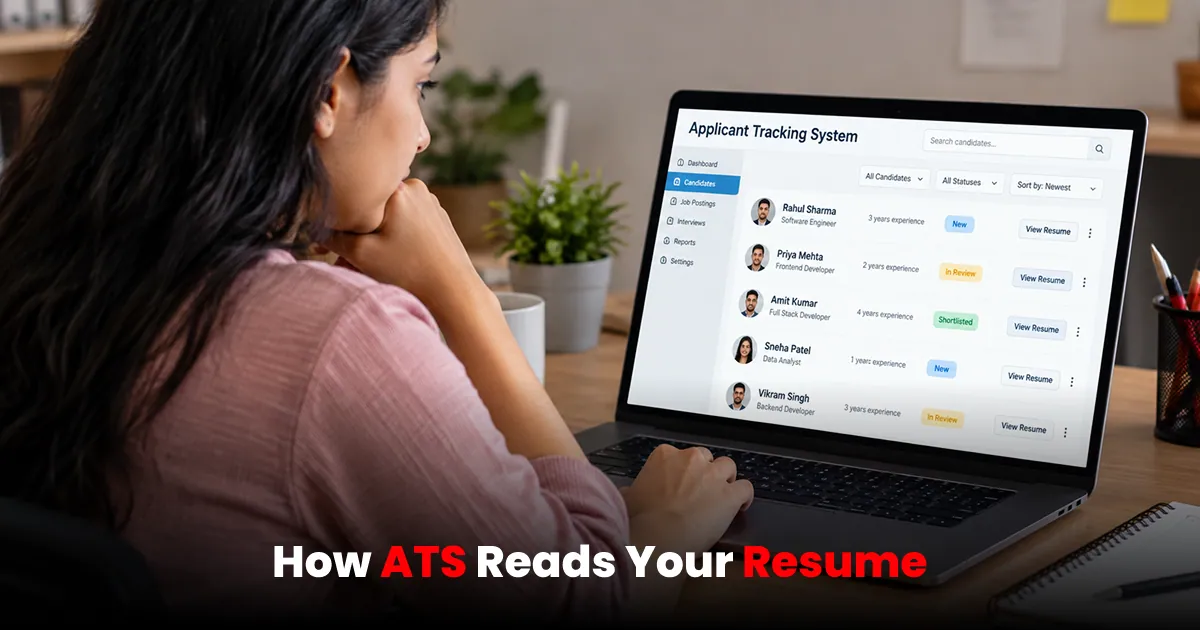
An ATS is basically a database for recruiters. When you apply, it pulls the text out of your file, tries to sort it into fields like name, education, skills and experience, and stores it. Later, a recruiter searches it with words like "Python", "B.Tech" or "Pune". If your details went into the wrong field, or did not come out at all, you will not show up in that search. Nobody rejected you. You were just never seen.
Some companies also set hard filters, like a minimum percentage or a graduation year. So those details matter too.
Where Indian freshers will meet an ATS
- Job portals like Naukri, Foundit and LinkedIn, which have their own resume parsers
- Career pages of bigger companies, which often run on tools like Workday or Greenhouse
- Campus hiring portals, where your uploaded resume is stored and searched
- Small startups, which may just read resumes in email, but a clean layout helps there as well
Keep the layout boring
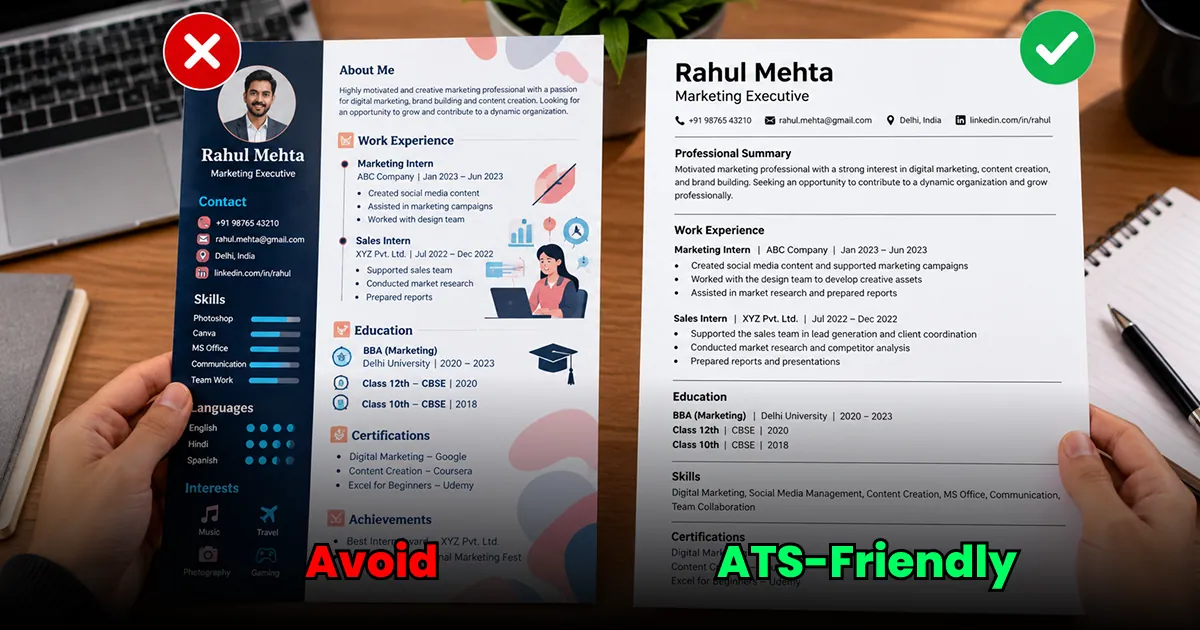
Software reads one line at a time, from top to bottom. Anything that makes it jump around, like columns, sidebars and text boxes, causes trouble. Boring layouts win.
| Element | Safe choice | Risky choice |
|---|---|---|
| Layout | One column | Two or three columns, sidebars |
| Font | Arial, Calibri or Times New Roman, 10 to 12 pt | Handwriting style fonts |
| Headings | Education, Projects, Skills, Internships | "My Journey", "What I Bring" |
| Graphics | None | Icons, skill bars, pie charts |
| Photo | Leave it out | Passport photo in the corner |
| Contact details | In the main body of the page | Only in the page header |
| File type | Text-based PDF or .docx, whichever the company asks for | A PDF that is really a flat image |
| File name | Rahul_Verma_Resume.pdf | resume_final_v3_new.pdf |
| Length | One page | Two pages with school-level details |
30 second test: open your PDF, select all, copy, and paste into Notepad. If the order is wrong or something is missing, the parser will have the same problem.
Old biodata habits to drop
A lot of Indian resumes still follow the old biodata style. It worked for a different time. Today it takes space and adds nothing.
- Remove the photo, date of birth, father's name, religion, marital status and caste
- Delete the "I hereby declare that the above information is true" line at the bottom
- Replace "Seeking a challenging role in a reputed organisation" with a real two-line summary
- Write your phone number in a clear format like +91 98765 43210
- Give your city and state, since recruiters filter by location, but skip your full home address
- Write your CGPA or percentage the way your university gives it, and mention which one it is
- Do not list "MS Office" and "Internet" as skills, because everyone is assumed to have them
Where keywords come from
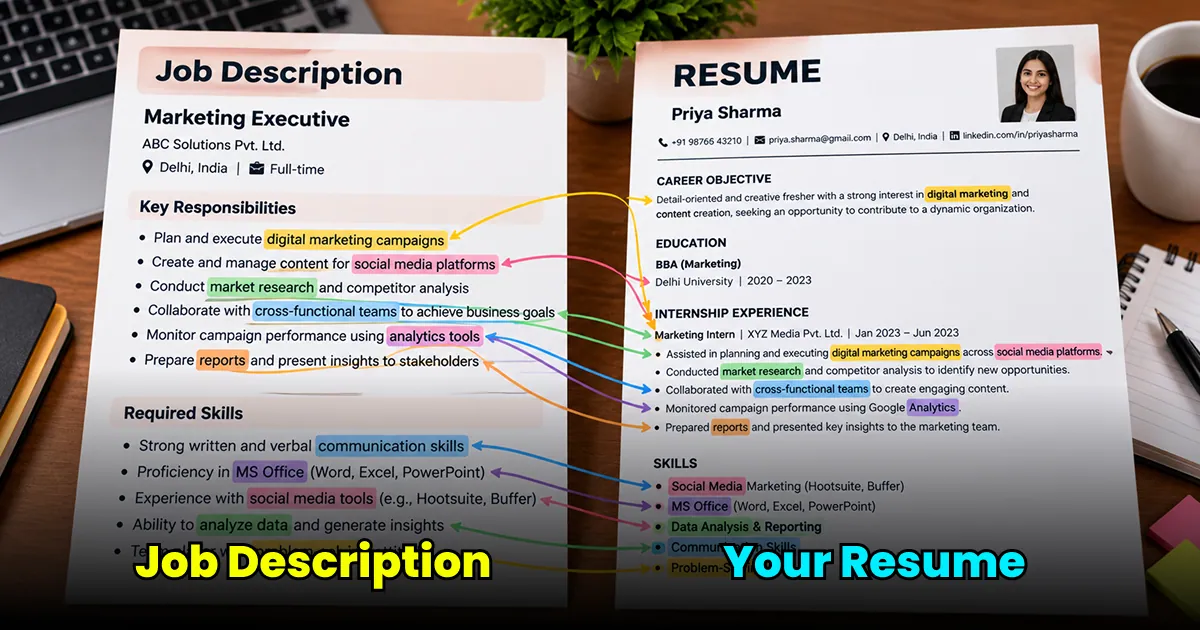
Keywords are just the words the employer used to describe the job. So your source is the job posting itself. Read it twice, notice which words repeat, and if you honestly have those skills, use the same words in your resume.
- Copy the job description into a notepad
- Underline the tools, skills and qualifications that appear more than once
- Check which of them you really have
- Add those words to your summary, projects and skills section, where they fit naturally
| Fresher role | Words you often see in job postings |
|---|---|
| Software developer | Java, Python, SQL, OOP, data structures, Git, REST API |
| Data analyst | Excel, SQL, Power BI, Tableau, data cleaning, dashboards |
| Digital marketing | SEO, Google Analytics, Google Ads, social media, email campaigns |
| Accounts and finance | Tally, GST, bookkeeping, reconciliation, Excel |
| HR and recruitment | Sourcing, screening, onboarding, ATS, communication |
| Customer support | CRM, ticketing, English and Hindi, typing speed, query resolution |
| Sales and business development | Lead generation, client communication, CRM, negotiation |
Use this as a rough guide, not a list to copy. The job posting in front of you always matters more than any table.
Do not paste fifty keywords in white font at the bottom of the page. Recruiters notice it, newer systems flag it, and it can get your application dropped. Use only words for skills you actually have.
How to write each section
Summary
Two lines are enough. Say your degree, your main skills, and the kind of role you want. Skip words like "hardworking" and "passionate", because everyone writes them.
Education
Write the degree, college, city, years and CGPA or percentage in one or two lines. For a fresher, 12th and 10th marks can be one short line each, or left out if your graduation marks are strong and the form does not ask.
Projects
For freshers, projects are the main proof of skill. A simple formula works well for each project.
- Name of the project and the tools used
- The problem it solved
- What you built
- A result, even a small one, like number of users or time saved
Skills
Group skills by type, like languages, tools and concepts. Do not use percentage bars or star ratings. They mean nothing to software, and a person cannot tell what "60% in Java" is supposed to show.
Internships, certificates and extras
List internships with the company, duration and what you actually did. Add only certificates that match the role. If you have no internship, college club work, hackathons, volunteering and freelance tasks can fill that space, as long as you describe what you did in plain words.
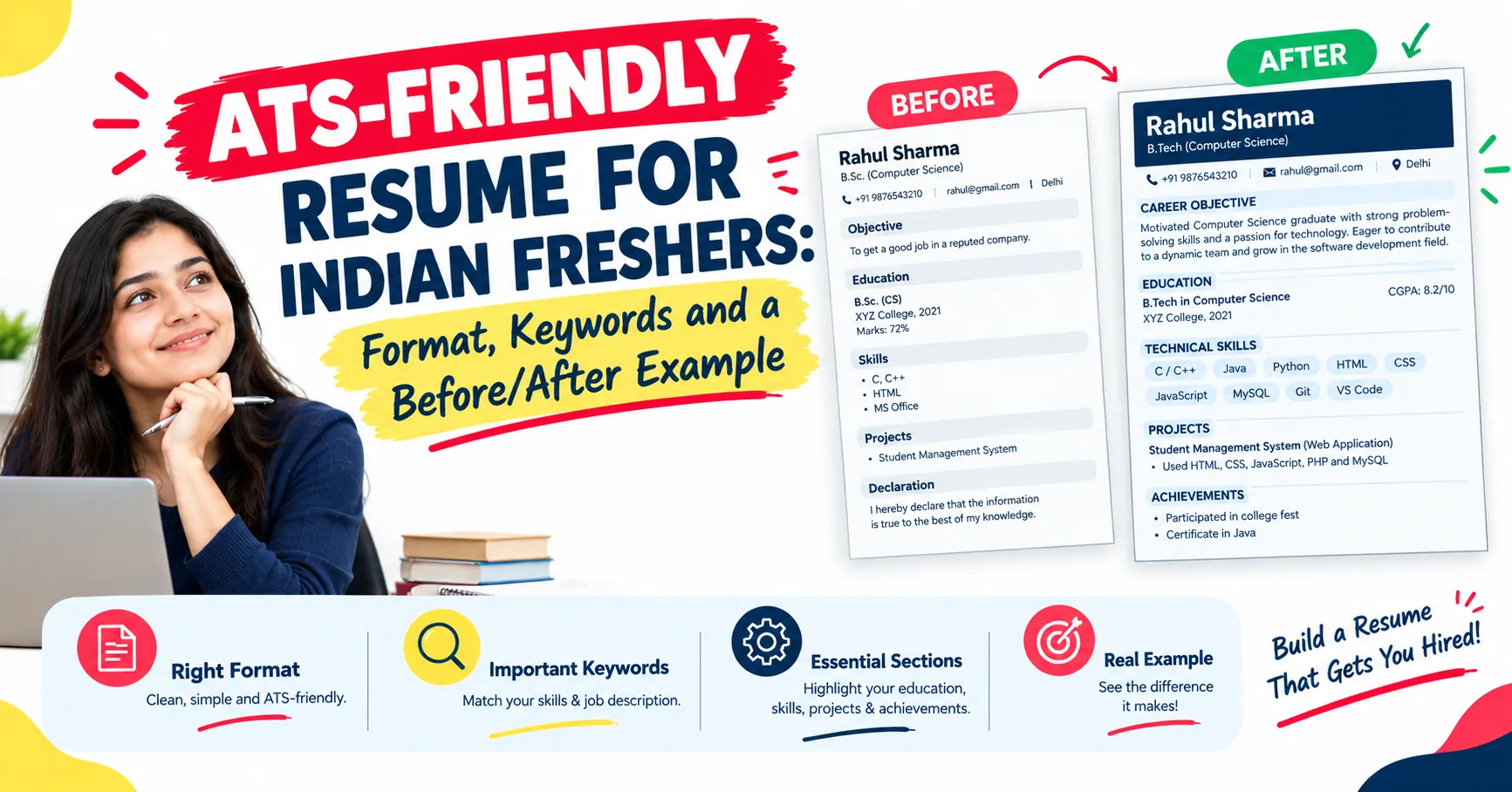
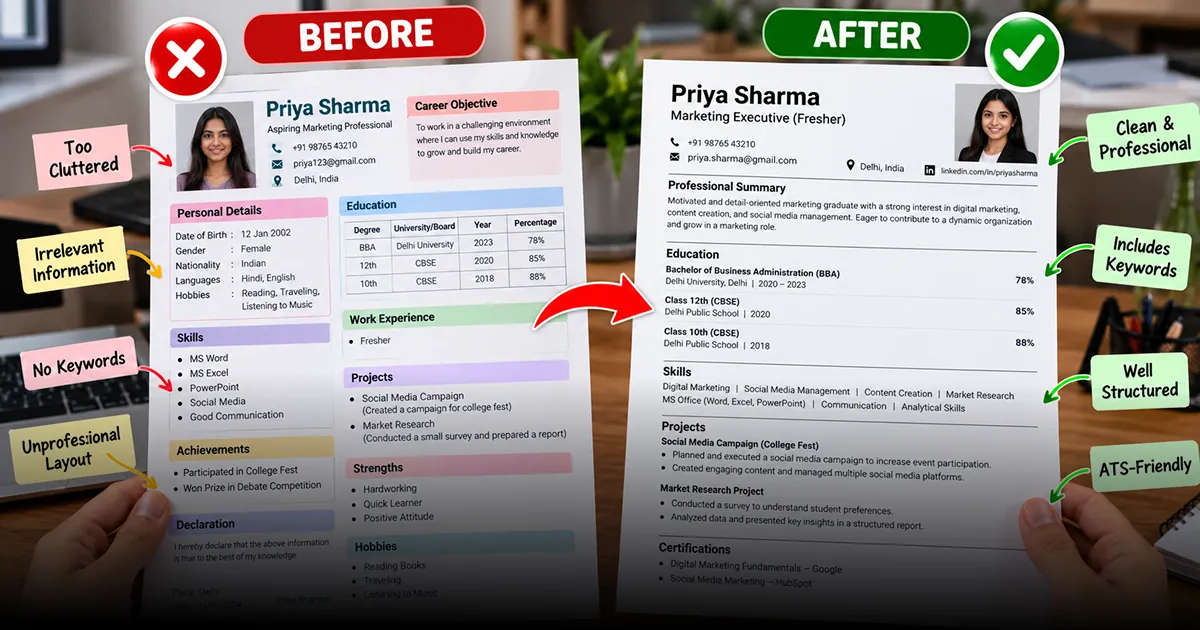
Sample resume: before and after
The sample below uses a made-up candidate. The "before" version has problems that appear on many fresher resumes.
| Section | Before |
|---|---|
| Top of page | [Passport photo] RAHUL VERMA. Date of Birth: 12/03/2002. Father's Name: Mr. S. K. Verma. Religion: Hindu. Marital Status: Unmarried. Full home address with pin code |
| Objective | Seeking a challenging position in a reputed organisation where I can utilise my skills and grow with the company. |
| Skills | Python ■■■■□ (80%), Java ■■■□□ (60%), Hardworking, Team player, MS Office, Internet, Quick learner |
| Projects | Library Management System. College Website. |
| Education | Inside a coloured sidebar, with class 10, 12 and graduation marks in a small table |
| End of page | Declaration: I hereby declare that all the above information is true to the best of my knowledge. |
What is wrong with it:
- The photo and family details do nothing for a recruiter
- The objective could belong to any candidate
- Skill bars mean nothing to software or to people
- The projects are just two titles, with no tools or results
- The coloured sidebar may turn into scrambled text after parsing
- A recruiter searching for "SQL" or "Java developer" would probably never find this resume
| Section | After |
|---|---|
| Header | Rahul Verma | Pune, Maharashtra | +91 98765 43210 | rahul.verma@email.com | linkedin.com/in/rahulverma | github.com/rahulverma |
| Summary | Computer Science graduate with hands-on experience in Java, Python and SQL through two complete projects, looking for a junior software developer role where I can write production code and learn from experienced engineers. |
| Education | B.Tech, Computer Science. XYZ Institute of Technology, Pune. 2020 to 2024. CGPA 8.1 out of 10 |
| Projects | Library Management System (Java, MySQL): built a desktop app to issue and return books and track late fines, replacing a paper register. About 500 books and 200 members entered. Department Website (HTML, CSS, JavaScript): six pages covering notices, faculty, timetable and contact, working on mobile too. |
| Skills | Languages: Java, Python, SQL. Web: HTML, CSS, JavaScript. Tools: Git, GitHub, MySQL, VS Code. Concepts: Object-Oriented Programming, Data Structures, REST APIs |
| Internship | Software Intern, ABC Tech (6 weeks): fixed 12 front-end bugs and wrote unit tests for a billing module |
| Certifications | Java Programming Masterclass (Udemy), SQL for Data Analysis |
The candidate's marks, projects and internship are exactly the same in both versions. Only the writing changed. The keywords now sit where a search can find them, the projects say what was built and what it replaced, and the page is plain enough for any parser to read.
How to test your resume before sending
- Do the Notepad paste test described above
- Open the job posting and check that the repeated words show up in your resume, but only for skills you really have
- Keep your phone number and email in the body of the page, not in a header
- Write dates in one format everywhere, like Jun 2023 to Aug 2023
- Open the file on your phone, because many recruiters first see it there
- Ask a senior or friend to look at it for two minutes and tell you what they noticed first
Common mistakes
- Using a beautiful free template that turns into a mess when read as text
- Hiding keywords in white font
- Sending the same resume to every company without checking the job posting
- Uploading a PDF that is really a flat image with no text in it
- Listing skills you cannot talk about in an interview
- Writing a long paragraph of duties instead of short lines with results
Last check before you hit send
| Check | Done? |
|---|---|
| One column, standard headings, plain font | ☐ |
| No photo, date of birth, father's name or declaration | ☐ |
| Keywords from the posting used naturally, only where true | ☐ |
| Projects say what you built, with what, and the result | ☐ |
| Sensible file name and the file type they asked for | ☐ |
| Read once, out loud, for typos | ☐ |
Common questions
Do I need a different resume for every job?
Not a full rewrite. Keep one base resume and change the summary and the skills order to match each posting. That takes ten minutes and makes a real difference.
PDF or Word, which one is better?
Use whatever the company asks for. If nothing is mentioned, a text-based PDF is usually safe. Just make sure you can select and copy the text from it.
Is one page enough for a fresher?
Yes. A fresher with school and college details, a couple of projects and one internship fits easily on one page. A second page usually just adds filler.
Can I use a Canva template?
You can, but be careful. Many Canva templates use columns, icons and text boxes, which are exactly what parsers struggle with. If you use one, pick a single-column design, remove the graphics and run the Notepad test.
Are paid ATS score checkers worth it?
Treat the scores with caution. Every real system works differently, so no single score tells you how a company's software will read your file. A clean layout, honest keywords and the Notepad test give you more than a number.
Should I put my CGPA if it is low?
If the job posting asks for a minimum score, you need to state it honestly. If it does not, focus on your projects and skills, but do not lie or hide it when someone asks directly.
Final thoughts
An ATS-friendly resume is not a trick. It is simply a resume that a machine and a tired recruiter can both read without effort. Fix the layout, remove the old biodata habits, use honest keywords and write your projects with real results. After that, you are judged on your skills, and that is something you can keep improving.
Did changing your resume improve your replies? Tell us what you changed in the comments, it might help another fresher.

Comments
No comments yet. Be the first to comment.