
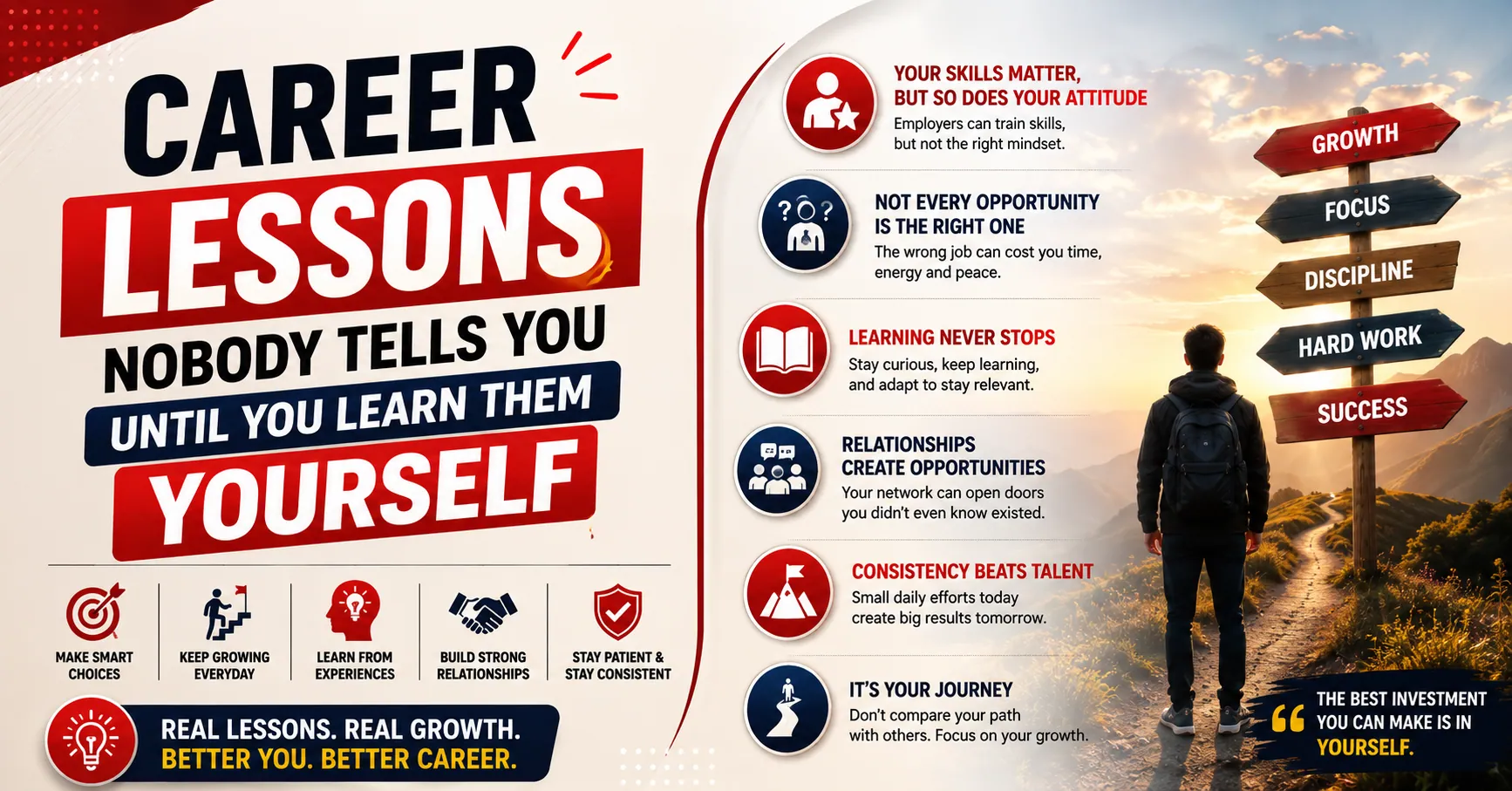
There's a strange gap between what career advice sounds like on paper and what actually happens once you're sitting at a desk on your first day, nodding along to instructions you don't fully understand. Most advice you get before starting a job is either too generic — "work hard, be punctual, network well" — or too specific to someone else's industry to be of much use to you. The lessons that actually matter tend to show up later, usually after you've already messed something up or sat through an awkward meeting wondering why nobody warned you about this earlier.
So instead of another list of obvious tips, here's a rundown of the things that tend to surprise people once they're actually in the middle of building a career, not just reading about one.
Your First Job Title Matters Less Than You Think
A lot of people stress over whether their first role has an impressive enough title. The truth is, five years down the line, almost nobody cares what your first designation was. What they care about is what you were actually responsible for, what you learned, and whether you can talk about it with some confidence. A slightly underwhelming title with real hands-on work will usually take you further than an inflated title where you spent most of your time waiting for someone to hand you a task.
If you're choosing between two offers and one has a fancier title but less actual responsibility, it's worth thinking twice before picking the title over the experience.
Nobody Is Going to Hand You a Roadmap
This one catches almost everyone off guard. In school and college, there's always a syllabus, a deadline, someone telling you what's expected next. Work doesn't really function that way, especially once you're past the very first few months. Managers are busy, priorities shift, and a lot of the time you're expected to figure out what needs doing before someone explicitly tells you.
This isn't a flaw in the system — it's just how most workplaces run. The people who tend to grow faster aren't necessarily the smartest ones in the room; they're often the ones who got comfortable asking questions early, tracking their own progress, and not waiting around for permission to take initiative on small things.
Feedback Feels Worse Than It Is
Getting told that something you did wasn't quite right stings, especially early on when you're still trying to prove yourself. It's easy to read criticism as a judgment on your ability rather than what it usually is — a comment on one specific piece of work. Most managers giving feedback aren't trying to make a point about your worth as an employee; they're just trying to get the actual output closer to what's needed.
It helps to separate the emotional reaction from the actual content of what's being said. Write the feedback down if you have to, sit with it for a bit, and come back to it once the initial sting has faded. Nine times out of ten, it reads a lot more reasonable an hour later than it did the moment you heard it.
Staying Too Long Can Be as Risky as Leaving Too Soon
There's a lot of advice out there warning people against job-hopping, and there's some truth to that — constantly switching jobs every few months can raise questions. But the opposite mistake happens just as often and gets talked about far less: staying in a role for years past the point where you're actually learning anything new.
If a role has flattened out — no new skills, no new responsibility, no real growth in pay or scope — comfort alone isn't a strong enough reason to stay. It's worth periodically asking yourself whether you're still growing where you are, or just familiar with where you are. Those are two very different things. Here's a rough way to check where you actually stand:
| Signal | Time to Stay | Time to Start Looking |
|---|---|---|
| Learning | You're still picking up new skills every few months | Your day-to-day hasn't changed in over a year |
| Responsibility | Your scope of work keeps expanding | You're doing the exact same tasks as when you joined |
| Pay & Growth | Appraisals reflect your actual contribution | Raises feel more like inflation adjustments than growth |
| Motivation | You still feel some pull toward the work | You're mentally checked out most days |
None of these signs alone means it's time to quit tomorrow. But if most of them start pointing the same direction for a few months in a row, that's usually not a phase — that's a pattern worth paying attention to.
Networking Doesn't Have to Feel Fake
A lot of people avoid networking because it feels transactional, like you're only talking to someone because you want something from them. But most of the useful professional relationships people build happen almost by accident — a colleague from an old job, someone you met at a training session, a senior who mentored you briefly and stayed in touch. Keeping those connections alive doesn't require constant effort; an occasional message asking how someone's doing, or congratulating them on a new role, keeps the door open without it feeling forced.
The people who end up with a strong professional network usually didn't set out to "build" one in a calculated way — they just didn't let old connections go cold.
Burnout Doesn't Always Look Like Exhaustion
Most people imagine burnout as being visibly tired all the time, but it often shows up more quietly — a growing sense of indifference toward work you used to care about, irritability over small things, or just going through the motions without really being present. It's easy to miss because it doesn't always come with an obvious low-energy day; sometimes it just comes with a slow loss of interest.
Catching it early matters more than people realize. Waiting until it turns into complete exhaustion before making changes — whether that's setting better boundaries, taking actual time off, or reconsidering the role itself — usually means a much longer recovery than if it had been addressed a few months earlier.
A few early signs worth watching for, before it snowballs into something bigger:
- Dreading Monday starts well before Monday actually arrives, even on an otherwise normal weekend
- Finding yourself annoyed by things that never used to bother you at work
- Doing tasks just to get them off your plate, without much thought about doing them well
- Feeling tired in a way that a good night's sleep doesn't really fix
- Losing interest in conversations about work you'd usually have had opinions on
The Long Game Usually Beats the Quick Win
Early in a career, it's tempting to chase whatever looks impressive right now — the highest starting salary, the flashiest company name, the fastest promotion. Those things aren't unimportant, but they aren't everything either. A slightly lower-paying job that teaches you skills you'll use for the next decade is often worth more in the long run than a higher-paying one that leaves you exactly where you started, skill-wise, two years later.
None of this means ignoring practical concerns like salary or stability — those matter too, especially depending on where someone is in life. It just means it's worth asking not only "what does this job pay me right now" but also "what does this job teach me that I get to keep, no matter where I go next."

Comments
No comments yet. Be the first to comment.