
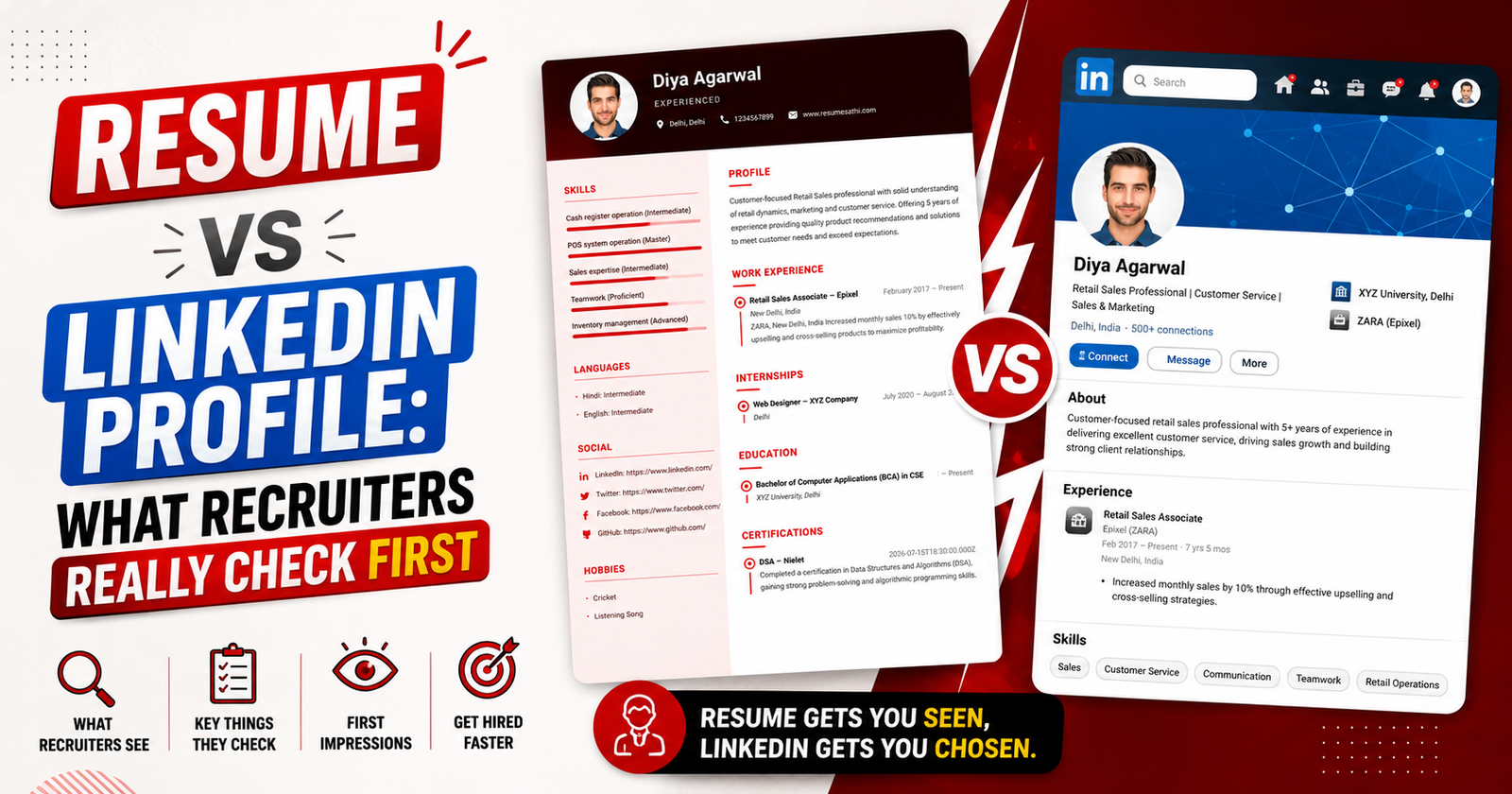
A recruiter once told me something that kind of stuck with me for years after — she said she'd already checked my LinkedIn before she even bothered opening my resume. At the time I thought that was odd. Wasn't the resume supposed to be the main thing? Turns out no, not really, not anymore.
If you're applying for jobs right now, you already know you need both. Fine. But here's what most people get wrong — they treat these two things like they're the same document, just in two different places. They're not. A recruiter doesn't read them the same way, doesn't look for the same things, and honestly doesn't even open them in the order you'd expect.
So let's actually get into it.
Why This Mix-Up Even Happens
Most people build their LinkedIn as basically a copy of their resume. Same job titles, same "responsible for managing X" type lines, nothing that actually sounds like them. And that's the problem right there — a lot of genuinely good candidates get skipped over just because their online profile reads like a template nobody bothered to personalize.
One document filters you out. The other one decides whether someone even wants to reach out in the first place. Different jobs, different documents.
Resume vs LinkedIn — Side by Side
| Factor | Resume | LinkedIn Profile |
|---|---|---|
| Main job | Gets you shortlisted for one role | Builds credibility over time |
| Format | Fixed PDF, one version at a time | Always changing, always live |
| Who's reading | The hiring manager, for this job only | Recruiters, old colleagues, clients, basically anyone |
| Tone | Formal, numbers-heavy | More personal, more story |
| Length | Kept to 1-2 pages | However long you want, really |
| Read first in 2026 | Usually not | Usually yes |
| How often updated | Only when applying somewhere | Constantly, almost like a running log |
That "read first" row is honestly the whole point of this article, if I'm being blunt about it.
What Recruiters Actually Check on a Resume
By the time a recruiter has your resume open, they've mostly already decided you're worth a look. So now they're not reading line by line — they're scanning for a handful of specific things.
| What they check | Why |
|---|---|
| Keywords matching the JD | ATS software filters on this before a human even sees it |
| Numbers, not vague claims | "grew revenue 22%" lands better than "handled sales" |
| Progression | Are you growing, or just moving sideways job to job |
| Layout | A messy resume, fair or not, reads as a messy person |
| Employment gaps | They'll ask about it eventually, so don't try to hide it |
One thing that's changed a lot lately — most companies now run resumes through AI-assisted ATS before anyone human looks at it. And these systems aren't dumb keyword counters anymore, they actually understand context. So the old trick of jamming buzzwords everywhere doesn't really work like it used to.
What Recruiters Actually Check on LinkedIn
This part's different. There's no real checklist for LinkedIn, it's more of a gut impression thing.
| What they check | Why |
|---|---|
| Photo and banner | People judge this in like 2-3 seconds, whether we admit it or not |
| Headline | If it's just your job title, you're wasting the space |
| About section | Sounds like a real person, or copy-pasted from somewhere |
| Activity | Are you actually around, or is this account basically dead |
| Recommendations | Someone else vouching for you carries weight |
| Endorsed skills | Adds a layer of proof beyond what you say about yourself |
| Mutual connections | Trust builds faster when there's already some overlap |
Something a lot of job seekers don't realize — recruiters are now leaning on LinkedIn's own AI search and summary features to shortlist people before sending a single message. So if your profile's thin or hasn't been touched since 2021, you could get filtered out of a role you never even knew existed.
Don't Make Them Twins
I know this sounds like it goes against the "keep everything consistent" advice you've probably heard a hundred times. But consistency just means the facts line up — titles, dates, companies. It doesn't mean the writing has to be identical.
Resume version:
"Led a team of 6 to deliver a product redesign that cut customer complaints by 30%."
LinkedIn version:
"Complaints kept piling up that quarter and at some point I just couldn't keep ignoring it. Grabbed five people from the team, we tore apart the user flow from scratch — took about three months, a lot of it messier than I'd like to admit. But by the end complaints were down 30%, and it's still one of the projects I bring up when people ask what I'm proud of."
Same achievement, told two different ways, for two different audiences. Both are true. Both work.
Mistakes People Are Still Making
- Resume photo (or worse, LinkedIn photo) that's basically five years out of date
- Sending the identical resume to every single application, no tailoring at all
- LinkedIn headline that's literally just your job title and nothing else
- Never touching the "Open to Work" settings, so you're invisible to recruiter search
- Ghost profile — zero posts, zero comments, nothing for months on end
- Skipping recommendations because "they're not that important" (they are, now more than ever)
The Way I'd Sum This Up
Your resume is answering one question: can this person actually do the job. Your LinkedIn is answering a slightly different one: do I want to talk to this person, and can I trust what they're telling me.
There's more competition than ever right now, a lot of it AI-assisted applications flooding every posting. Which honestly makes the human stuff stand out more, not less — real stories, actual numbers, a personality that comes through instead of a generic template.
Before You Hit Apply
- Resume actually tailored to this job, not the same one you send everywhere
- LinkedIn headline says more than just your title
- At least a couple of recent recommendations up
- Photo's current, looks like you look now
- Resume and LinkedIn facts match, even if the tone doesn't
- You've posted or commented on something in the last month
Get this right and you stop being just another name in the pile.
Curious — does anyone actually check your resume first these days, or is it LinkedIn every time? Let me know in the comments.

Comments
No comments yet. Be the first to comment.